
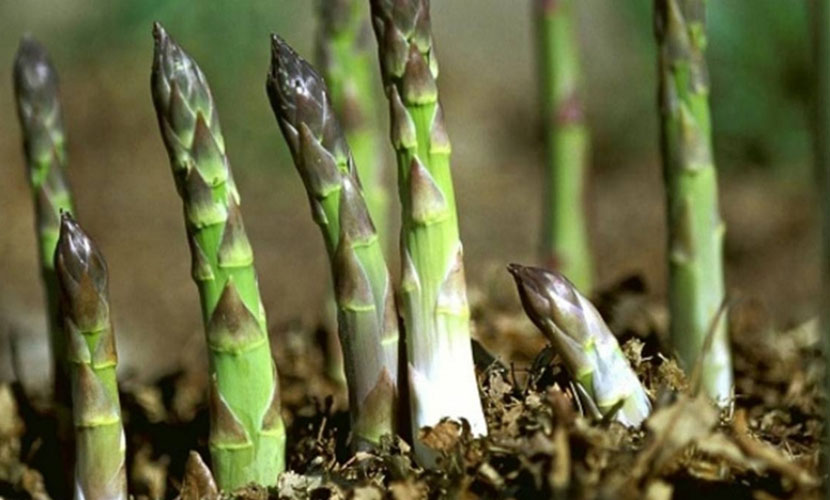
From an arid land shaped by harsh sunshine and strong winds, Vietnamese asparagus has emerged as a key agricultural product. Therefore, it provides sustainable economic development opportunities for the Cham people in Khánh Hòa Province.
Khánh Hòa Province has long been famous as one of Vietnam’s most climatically harsh localities. As a result, farmers have had to cope with prolonged heat, infertile soil, and year-round water shortages. Under such conditions, finding a crop that could both adapt to the environment and generate substantial economic value was a persistent challenge. The answer emerged more than a decade ago with the introduction of green asparagus.
Known as the “king of vegetables”, asparagus is a premium crop that often commands high prices in the market. The crop was a trial basis to the fields of the Cham community in Ninh Phước and Ninh Hải. These areas were formerly part of Ninh Thuận and are now within the administrative boundaries of Khánh Hòa following administrative reorganization. The crop thrived, delivered stable yields, and quickly became a leading agricultural product.
Vietnamese asparagus
While Cham farmers had previously relied on maize, rice, and cassava cultivation, asparagus brought about a fundamental transformation. On average, each hectare of Vietnamese asparagus generates annual earnings of VND 350–400 million. This figure is several times higher than those of traditional crops. Moreover, because Vietnam’s asparagus gives daily harvest, it provides a continuous source of income. As a result, farmers enjoy a stable cash flow and are less vulnerable to extreme weather conditions.
Hundreds of Cham households have escaped poverty thanks to this crop. Moreover, many families have improved their living standards and built new homes. As a result, they have been able to provide better educational opportunities for their children. For women, asparagus cultivation has also created sustainable employment opportunities. Planting, caring for, and harvesting the crop are suitable tasks that farmers can carry out consistently throughout the year.
In addition to improving economic well-being, Vietnamese green asparagus has helped transform farming practices. Cham farmers have adopted advanced cultivation techniques, including water-saving drip irrigation systems. They also comply with Vietgap and organic production standards. As a result, they are able to create high-quality products that meet increasingly stringent market requirements.
The remarkable success of asparagus cultivation in Khánh Hòa is not solely the result of farmers’ efforts. It also closely linked to the pivotal role of agricultural cooperatives. In a context where agricultural production is often small-scale and fragmented, cooperatives have helped reorganize production. They have done so by bringing farmers together into concentrated growing areas, ensuring product consistency and facilitating market access.
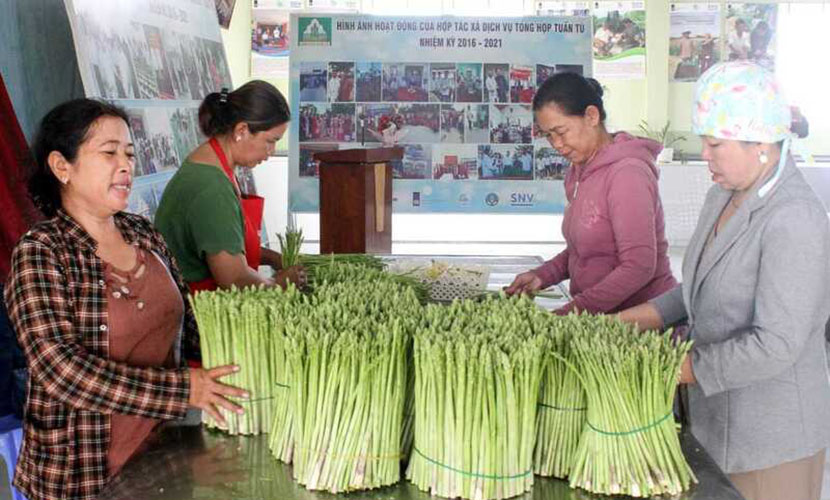
Vietnamese asparagus facillity
Representative examples include Xuân Hải Cooperative, An Hải Cooperative, and Tuấn Tú Cooperative. These cooperatives not only provide seedlings, fertilizers, and cultivation techniques but also train farmers in quality control procedures and safe pest management practices. More importantly, they serve as a bridge between farmers and businesses by signing product off-take agreements. They supply asparagus to major supermarket chains in Hanoi, Ho Chi Minh City, and Da Nang, while also connecting with networks of clean-food stores.
Mr. Hùng Ky is the Director of Tuấn Tú General Services Cooperative in Phước Dinh Commune, Khánh Hòa Province. He stated that the cooperative was established in 2016. Over the years, it has expanded its cultivation area from an initial 5 hectares managed by 13 member households to more than 44 hectares involving 85 Cham member households.
Thanks to the cooperative, many Cham families have secured sustainable livelihoods and stable incomes. This has contributed to poverty reduction and improved household economic well-being. Partner companies purchase the cooperative’s green asparagus under contract at a price of VND 50,000 per kilogram.
As a result, green asparagus in Khánh Hòa has avoided the common situation in which bumper harvests lead to falling prices, a challenge frequently faced by many agricultural products. Consumption remains stable, and prices are maintained at relatively high levels, ensuring benefits for farmers. Beyond the fresh market, several Vietnamese asparagus enterprises have also invested in developing processed products such as asparagus tea, asparagus powder, and dried asparagus. These products not only diversify market opportunities but also increase the added value of this “king of vegetables.”
In addition to supporting domestic consumption, cooperatives also play an important role in connecting farmers with export partners. Several shipments of asparagus have already been available in Japan and South Korea. This has opened up promising opportunities in international markets. This demonstrates that, with continued investment and strict adherence to safe production standards, green asparagus has the potential to become one of Khánh Hòa’s key export commodities in the near future.
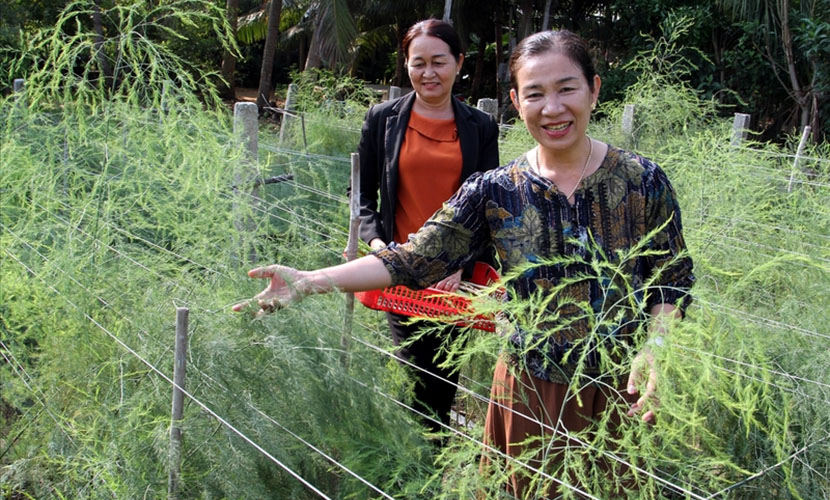
Vietnamese asparagus farm
Mr. Nguyễn Hữu Tuấn is the Director of a Vietnam’s asparagus company in Phan Rang Ward. He stated that the company currently cultivates more than 150 hectares of green asparagus. The company also supplies approximately four tons of fresh asparagus to the market each day. Of this amount, nearly three tons are exported to countries such as Japan and South Korea. To meet growing overseas demand, the company is preparing to expand its production area. It plans to increase its cultivation acreage to 200 hectares.
Looking back on its development journey, asparagus has truly become the “green gold” of the Cham community. To further enhance the value of this crop, Khánh Hòa is focusing on building the “Khánh Hòa Cham Asparagus” brand associated with geographical indication protection. This initiative is intended not only to affirm the product’s value but also to strengthen its competitiveness in both domestic and international markets.
Local authorities have coordinated with the Department of Industry and Trade and the Department of Agriculture and Environment to organize numerous trade promotion and marketing activities. These activities introduce the product at agricultural fairs and supply-demand matching events. At the same time, cooperatives are being encouraged to adopt digital technologies in production management, implement electronic traceability labels, and increase transparency throughout the production process. These efforts are intended to strengthen consumer confidence.
A new development direction is also emerging through the integration of agriculture and experiential tourism. Many visitors to Khánh Hòa now have the opportunity to tour asparagus farms, harvest the crop themselves, and enjoy fresh asparagus on-site. This model not only increases economic value but also helps promote the image of local agricultural products.
Vietnamese source: https://congthuong.vn/mang-tay-vang-xanh-cua-dong-bao-cham-419690.html
If you are interested in Vietnamese asparagus exports, please contact us:
Company: Agrideco Vietnam Co., Ltd.
Address: No 02, Alley 325 Kim Nguu, Vinh Tuy Ward, Hanoi, Vietnam
Tel/Kakao Talk/Whatsapp: +84 989 649 804
Website: https://agridecovietnam.com
Email: agridecovietnam@gmail.com