
Arriving in Binh Tan District—a once-famous cultivation hub of Vietnamese sweet potatoes in the Mekong Delta today—one can easily notice a striking change. Amid vast stretches of sweet potato fields, farmers have converted many plots. Some are now ready for embankments and seedlings for mango, pomelo, and orange cultivation. Others have been flooded, reclaimed, and improved for rice farming.
Ms. Nguyen Hong Nhung is a farmer in Thanh Loc Hamlet, Thanh Trung Commune. Her family owns 6 cong of land previously used for cultivating Japanese purple sweet potatoes. Her family has now switched to rice farming and has harvested three rice crops. She explains that continuous sweet potato cultivation often degrades soil quality and increases pest pressure.
Therefore, she plans to grow rice for one or two seasons before potentially returning to sweet potatoes. However, the family has agreed that as long as rice remains more stable and economically secure, it will continue to be the main crop.
“Growing rice is less profitable, but it’s safer. Vietnamese sweet potatoes are very hard to grow and often result in losses,” Nhung said. “Each cong of sweet potato requires 15–20 million VND in investment. Sometimes the harvest is only enough to cover labor costs. After harvesting, you have basically left with nothing. Prices fluctuate too much. After two losing seasons, you run out of capital.”
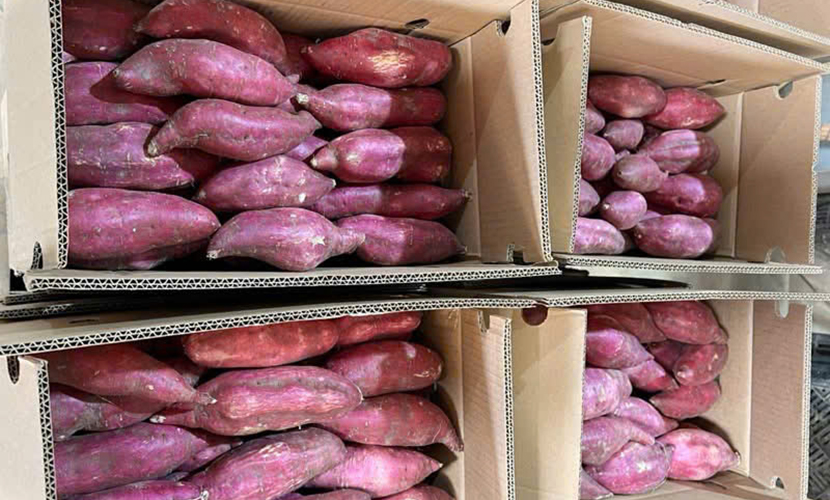
Vietnamese sweet potatoes
Ms. Nguyen Thi Chin is another farmer in Tan My Hamlet, Tan Thanh Commune. More decisively, she has converted 8 cong of sweet potato land into Thai jackfruit cultivation. She believes jackfruit could bring profits many times higher than Vietnamese sweet potatoes when prices are favorable. She said she stopped growing sweet potatoes because of repeated losses and unstable prices. Meanwhile, fruit crops offered more stable prospects after the initial investment.
Binh Tan District is the largest sweet potato cultivation area in the Mekong Delta. It has a total area of around 13,000 hectares and annual production of approximately 300,000 tons. About 80% is Japanese purple sweet potatoes for export, while 20% consists of red and milk sweet potatoes for domestic consumption. During peak seasons, Vietnamese vegetable companies purchase 100–200 tons for export to Southeast Asian markets.
Before 2016, export prices peaked at around 1.2 million VND per quintal (60 kg). Between 2017 and 2019, prices declined but remained relatively acceptable at 480,000–510,000 VND per quintal. However, from 2020 onwards, prices fell sharply. They dropped from 240,000 VND per quintal to 90,000 VND. In 2021, prices even dropped to around 50,000 VND.
In the 2022 season, the entire district planted only 699 hectares of Vietnamese sweet potatoes. This was a decrease of 6,300 hectares in comparison to the same period in previous years. Only 250 hectares had finished harvesting, but prices remained low at around 100,000 VND per quintal.

Vietnamese sweet potato box
Phan Tuan Thanh is the Director of Thanh Binh Tan Sweet Potato Co., Ltd. He said that the decline in production has led to fewer purchasing hubs. “Previously, there were many traders, and all output was purchased. But this year, many have stopped operating,” he noted.
One of the key external factors behind the prolonged price decline is trade disruption due to disease-control policies in importing countries. China has traditionally been the largest market, accounting for about 80% of Binh Tan’s fresh sweet potato exports. This is followed by Japan, Malaysia, and Indonesia. However, border trade channels have recently been largely frozen.
Thanh added that demand still exists, but customs clearance has limited due to strict disease-control measures. Many shipments are being blocked at the border because Vietnamese sweet potatoes are not going through official channels.
Local farmers have already converted a large area from sweet potatoes to other crops, and this trend continues to expand. The shrinking cultivation area means a reduction in raw material supply. The “Sweet Potato Kingdom” is gradually abandoning its signature crop. Farmers are now waiting for new policies and market stability. These conditions could allow them to confidently return to sweet potato cultivation and restore livelihoods tied to this crop.
Vietnamese source: https://vovgiaothong.vn/khi-vuong-quoc-khoai-lang-tinh-chuyen-bo-khoai-d27149.html
If you are interested in Vietnamese sweet potatoes, please contact us:
Company: Agrideco Vietnam Co., Ltd.
Address: No 02, Alley 325 Kim Nguu, Vinh Tuy Ward, Hanoi, Vietnam
Tel/Kakao Talk/Whatsapp: +84 989 649 804
Website: https://agridecovietnam.com
Email: agridecovietnam@gmail.com