

Vietnam-origin coffee exports in recent months have continued to show a notable paradox: export volumes are increasing while export value is declining. This trend highlights the urgent need to enhance export value. It also emphasizes the need to expand access to higher-price markets. In addition, it calls for stricter compliance with traceability, quarantine, and labeling requirements in importing countries.
Vietnam’s coffee export market in early 2026 has come under clear pressure from a downward price trend. Global conditions are partly responsible. Expectations of a larger new crop supply from Brazil have led coffee futures prices to decline in early June 2026.
However, a key feature of Vietnam’s coffee exports is that volumes are still rising while export earnings are falling sharply. The deeper decline in value compared with output indicates that price pressure is the main challenge facing the sector.
In May 2026, Vietnam-origin coffee exports reached 143,000 tons, worth USD 639.4 million. Compared to April 2026, this represented a decline of 24.7% in volume and 22.3% in value.
Overall, in the first five months of 2026, Vietnam-origin coffee exports reached 927,300 tons worth USD 4.23 billion. This went up 7.8% in volume but down 13.5% in value compared to the same period in 2025.
Vietnam-origin coffee exports
This is a development that should be viewed cautiously. Rising export volumes indicate that Vietnam-origin coffee exports still maintains strong demand in importing markets. However, when export value declines despite higher volumes, it shows that overall export efficiency is being eroded by falling average prices.
In May 2026, the average export price of Vietnamese coffee reached USD 4,471 per ton. This was up 3.2% from April 2026 but down 21.8% compared to May 2025.
For the first five months, the average export price stood at USD 4,557 per ton. This was down 19.7% year-on-year. This shows that a 7.8% increase in volume was not enough to offset the nearly 20% drop in average prices. As a result, total export value declined.
This development also reflects Vietnam’s coffee exports’ heavy dependence on global commodity price fluctuations. When world prices fall, domestic prices are immediately affected. On June 9, 2026, coffee prices in Dak Lak, Lam Dong, and Gia Lai fell by VND 1,800 per kg compared to June 1. Prices ranged from VND 85,000 to 85,600 per kg.
On the same day, coffee prices on international exchanges such as London, New York, and Brazil’s BMF also declined. This not only affects purchasing sentiment but also puts pressure on exporters in balancing supply, purchase prices, and delivery contracts.
Therefore, the key issue for Vietnam’s coffee sector is no longer just output. If Vietnamese coffee exporters continue focusing on raw or low value-added products, they will become increasingly vulnerable to global supply-demand cycles. This highlights the need to prioritize upgrading quality, expanding deep processing, and targeting higher-value markets.

Vietnamese arabica coffee
Vietnamese coffee exports have continued to maintain their presence in major consumption regions. Europe remains an important market. Germany and Italy show stable demand, recording increases of 5.8% and 18.1% respectively in volume during the first five months of 2026.
In the Americas, the United States remains one of Vietnam’s key export markets. Cumulative volume reached 66,912 tons worth USD 291.97 million. This was up 23.2% in volume but down 2.2% in value.
For large markets such as Germany, Italy, and the United States, maintaining export volume is necessary. However, potential for value growth depends increasingly on product structure and the ability to meet higher standards.
A notable bright spot is found in several Asian and emerging markets, particularly China. Imports increased by 47.9% in volume and 70.7% in value. This strong growth indicates significant opportunities for Vietnamese coffee enterprises. It is especially relevant as coffee consumption continues to expand in the Chinese market.
Mr. Pham Thang is the Vice Chairman of the Vietnam Coffee–Cocoa Association. He stated that Vietnamese coffee producers and enterprises are strictly complying with international traceability and phytosanitary requirements.
He added that Chinese partners may consider strengthening joint ventures and relocating packaging and deep-processing technologies closer to Vietnam’s raw material regions. This would help jointly enhance value creation across the coffee supply chain.
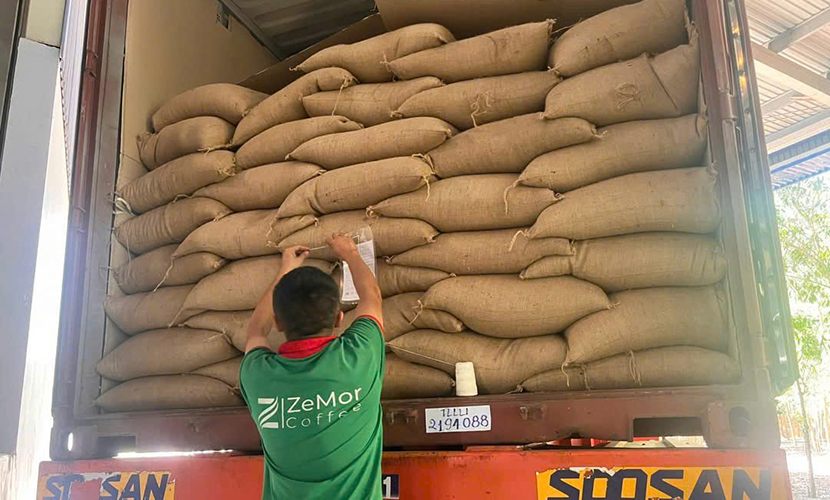
Loading Vietnamese coffee for export
Meanwhile, the South Korean market is showing increasing competitive pressure. In the first four months of 2026, the average import price of coffee into South Korea from global sources reached USD 8,855 per ton. This was up 14.4% year-on-year.
In contrast, the average import price from Vietnam fell by 10.2% to USD 4,205 per ton. Vietnam remains the country’s second-largest coffee supplier.
The large gap between global and Vietnamese coffee import prices in South Korea highlights a structural issue in product segmentation. Vietnam’s coffee is still mainly positioned in raw materials or low value-added segments. This limits value growth even while maintaining export volume.
Compliance pressure is also increasing as many countries tighten labeling regulations for processed foods, caffeine, and sweeteners. Products most affected include instant coffee, ready-to-drink coffee, and sugar-free products. This requires exporters to proactively adjust labeling, ensure ingredient transparency, provide nutritional information, and comply with specific technical requirements in each market.
The key direction for Vietnam-origin coffee exports in the coming period is not only to secure more export contracts. It is also to upgrade value across the supply chain, transforming volume advantages into quality, processing, and branding strengths. This is essential for reducing dependence on raw commodity price fluctuations. It also helps maintain market share in traditional destinations, expand export markets, and strengthen Vietnam’s position in the global coffee supply chain.
Vietnamese source: https://thuehaiquan.tapchikinhtetaichinh.vn/xuat-khau-ca-phe-tang-luong-nhung-giam-gia-159661.html
If you are interested in Vietnamese coffee exports, please contact us:
Company: Agrideco Vietnam Co., Ltd.
Address: No 02, Alley 325 Kim Nguu, Vinh Tuy Ward, Hanoi, Vietnam
Tel/Kakao Talk/Whatsapp: +84 989 649 804
Website: https://agridecovietnam.com
Email: agridecovietnam@gmail.com