
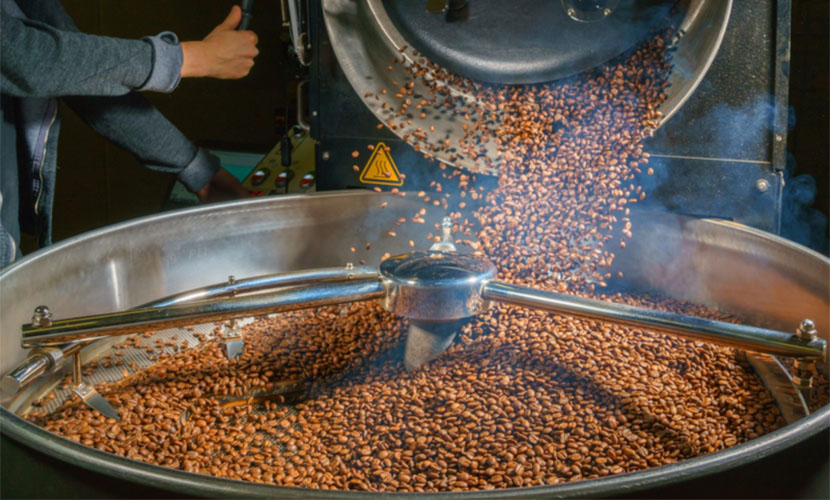
The sharp increase in global supply has driven world coffee prices downward. Vietnamese coffee exports are facing mounting pressure from declining export revenues and increasingly intense competition.
In April 2026, Vietnam exported approximately 189,894 tons of coffee, generating USD 822.5 million in revenue. In the first four months of 2026, Vietnam’s coffee exports reached around 782,017 tons. Accordingly, they went up 11.7% compared to the same period last year.
However, contrary to the increase in export volume, export turnover declined by nearly 10% to around USD 3.57 billion. The main reason was the sharp drop in global coffee prices compared to last year. In the first four months of 2026, the average export price of Vietnamese coffee fell to about USD 4,555 per ton. This represented a decline of nearly 20% year-on-year.
This trend clearly reflects the decline on international trading exchanges. Robusta coffee prices on the London exchange dropped from around USD 4,100 per ton in January to approximately USD 3,300–3,500 per ton in April. On average, Robusta prices in the first four months of 2026 fell by about 32% compared to the same period last year.
Meanwhile, Arabica prices on the New York exchange also declined sharply. They went from 370 US cents/lb to around 279–305 US cents/lb in April. This represented a decrease of about 14% year-on-year.
In the domestic market, prices of raw coffee beans have also continuously decreased. At the beginning of the year, Robusta prices were above VND 100,000 per kilogram. However, they have now fallen to around VND 85,500–89,200 per kilogram. Domestic Arabica prices have also dropped by approximately 24% compared to the same period in 2025.
Vietnamese coffee exports
Despite lower prices, trading activities remain relatively slow. Many farmers continue to hold back their stock in anticipation of a price recovery. As a result, domestic supply has not increased significantly in the short term. To ensure delivery schedules for signed contracts, several export companies have begun importing raw materials from Brazil and Indonesia.
Mr. Đỗ Hà Nam is Vice Chairman of the Vietnam Coffee-Cocoa Association (VICOFA). He stated that the biggest factor behind the sharp decline in coffee prices is the increasingly abundant global supply. The global coffee crop for the 2025/2026 season is likely to reach a record level of around 180 million bags. This figure goes up nearly 8 million bags compared to the previous season.
Most of the increase comes from Brazil’s Robusta production. Brazil alone will be able to produce around 65.1 million bags. If weather conditions remain favorable, production could potentially reach as much as 75 million bags.
While supply is increasing sharply, global coffee consumption has shown little change. According to VICOFA statistics, world coffee consumption in recent crop years has fluctuated around 172–176 million bags annually. “Conflicts in the Middle East may cause prices to rise slightly in the short term. However, the overall trend remains downward compared to 2025,” Mr. Đỗ Hà Nam commented.
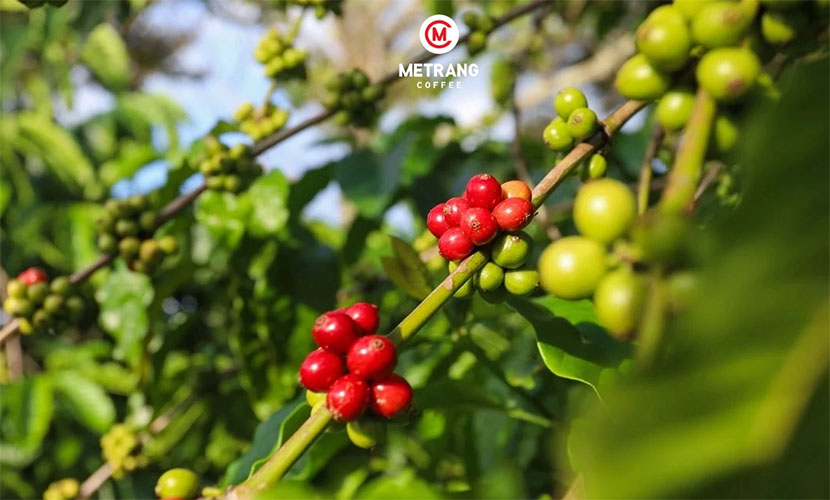
Green coffee from Vietnam
Notably, based on long-term trends, Vietnam’s coffee export volume in the second half of the year is usually lower than in the first half. Therefore, achieving “double-digit” export growth this year is considered quite challenging, especially in terms of export value.
Despite market volatility, the structure of Vietnamese coffee exports is showing positive signs. In the first four months of 2026, exports of roasted, instant, and blended coffee reached approximately 65,100 tons, generating around USD 600 million. This represented an increase of 17% in value compared to the same period last year. According to conversion standards set by the International Coffee Organization (ICO), processed coffee exports were equivalent to around 106,000 tons of green coffee beans. They accounted for 16% of the industry’s total export turnover.
According to VICOFA, amid the sharp decline in green coffee prices, boosting exports of deeply processed coffee products will be a key solution to offset falling export revenues. The association also recommends that Vietnamese coffee businesses increase exports of high-quality coffee and coffee products certified as green and sustainable. This would help enhance competitiveness in premium markets.
In addition, VICOFA has proposed strengthening trade promotion activities in potential markets such as China, Russia, South Korea, Algeria, and Nordic countries for specialty and organic coffee products. At the same time, the association emphasized the importance of improving market information support for businesses and producers.
According to experts, as the global coffee market enters a new cycle of competition, the industry’s growth potential no longer lies in output volume. Instead, it increasingly depends on quality, deep processing, and brand building. This will also be a crucial direction for Vietnamese coffee exports to maintain its leading export position amid continuing volatility in global prices.
Vietnamese source: https://congthuong.vn/xuat-khau-ca-phe-truoc-suc-ep-moi-456266.html
If you are interested in Vietnamese coffee exports, please contact us:
Company: Agrideco Vietnam Co., Ltd.
Address: No 02, Alley 325 Kim Nguu, Vinh Tuy Ward, Hanoi, Vietnam
Tel/Kakao Talk/Whatsapp: +84 989 649 804
Website: https://agridecovietnam.com
Email: agridecovietnam@gmail.com