
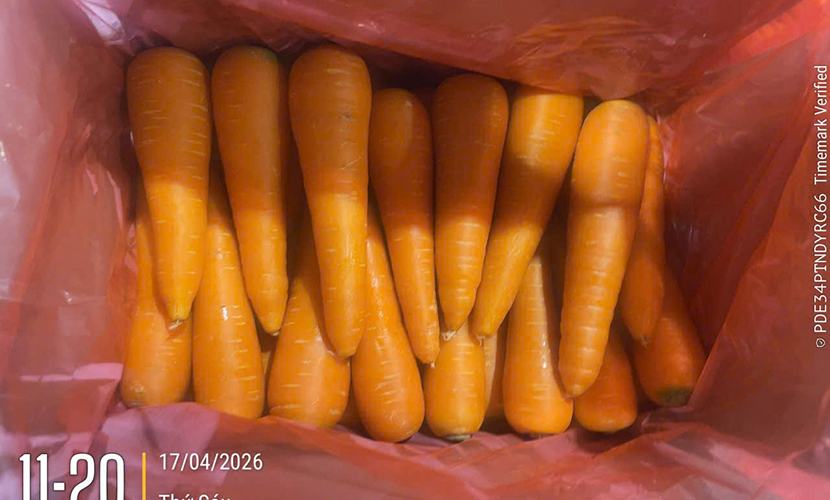
Xuan Tho Commune is a suburban area of the mountain city of Da Lat. It has long been proud as a traditional agricultural zone specializing in vegetables and flowers. The area is also famous for Vietnam-origin carrot that produces crisp, sweet, orange-colored roots. Today, local farmers are working to develop a clean carrot production zone.
Ms. Pham Thi Quy is a farmer from Da Quy Hamlet in Xuan Tho Commune. She said that most households in the area cultivate carrots. The traditional variety has purple stems, short plants, and sweet orange-yellow roots. It has passed down through generations. “People in Xuan Tho are very familiar with Vietnamese carrot farming that most every household grows them. Modern agriculture has changed, and many farms have switched to greenhouse flowers and vegetables. However, carrots remain closely tied to local farmers,” she said.
Farmers in Xuan Tho continue to cultivate traditional carrot varieties rather than new ones. According to locals, the traditional variety is well adaptable to the soil and easy to grow. Also, they understand its cultivation techniques well. It produces visually attractive, crunchy, and gives harvest three times per year.
Vietnam-origin carrot
Vietnam-origin carrot cultivation here follows a familiar cycle. Local farmers carefully till and raise into beds. Then, they fertilize with organic manure before sowing. After about 10 days, seeds germinate. At around 35 days, when plants reach approximately hand height, farmers thin the crop to ensure proper spacing.
After thinning, carrots grow rapidly and roots develop. Harvesting takes place after about 3.5 months. For seed production, farmers select high-quality roots, trim the leaves, and replant them to produce flowers and seeds. After that, they dry the mature seeds for the next planting season.
Carrot farming has long been a tradition in Xuan Tho. However, farmers are now gradually shifting toward higher-value and safer production models. Mr. Nguyen Duc Binh is the Chairman of the Farmers’ Association of Xuan Tho Commune. He said the locality is developing a safe carrot production zone. The commune currently has 125 hectares of concentrated carrot cultivation.
Agricultural authorities have established 22 cooperative groups producing carrots under VietGAP standards within this concentrated farming area. Each group consists of around 20–22 households located in close proximity. They work together under certified VietGAP production processes. About 80% of Xuan Tho’s carrot-growing area is now organized into safe production groups.

Vietnamese carrot farm
This collective farming model, combined with technical training and VietGAP certification support, has significantly improved farming practices. Farmers have shifted from traditional fertilizers such as fish-based compost and untreated animal manure to processed organic fertilizers. These are safer for both soil and crops. Many households are also adopting modern technologies such as climate and humidity sensors, automated irrigation systems, and organic-oriented cultivation methods.
Currently, average yields in Xuan Tho reach 3.5–4 tons per sào per crop. This is equivalent to approximately 110–120 tons per hectare per year.
According to Nguyen Duc Binh, farms participating in Vietgap-certified carrot cultivation should re-evaluate annually. Vietgap certification not only opens access to supermarkets and clean food retail chains. It also helps build the brand of “Da Lat Vietgap carrots.” While income from carrot farming is not highly volatile, it remains stable and relatively reliable.
More importantly, VietGAP-based cultivation helps enhance the reputation of Da Lat carrots. It also helps protect the local ecosystem and reduce the use of harmful long-term soil-impacting inputs. Xuan Tho continues to attract more farmers into VietGAP cooperative groups. This is strengthening the brand identity of Vietnam-origin carrot from the suburban area of the mountain city.
Vietnamese source: https://baolamdong.vn/xay-dung-vung-ca-rot-sach-ngoai-o-283986.html
If you are interested in Vietnamese fresh carrots, please contact us:
Company: Agrideco Vietnam Co., Ltd.
Address: No 02, Alley 325 Kim Nguu, Vinh Tuy Ward, Hanoi, Vietnam
Tel/Kakao Talk/Whatsapp: +84 989 649 804
Website: https://agridecovietnam.com
Email: agridecovietnam@gmail.com