

From a wild forest vegetable, Vietnam’s Bo Khai vegetable—traditionally foraged by the Tày and Nùng ethnic communities in the Central Highlands—has been developed into an organic cooperative model for cultivation. This transformation has helped shift the plant from wild harvesting to organized agricultural production. The cooperative now supplies both domestic markets and exports to Cambodia, China, and other destinations.
The model has also expanded its growing areas. It serves as a testament to the persistent efforts of ethnic minority communities in building modern agriculture. At the same time, it reflects their efforts to preserve cultural identity while reaching international markets.
In the 1980s–1990s, many Tày and Nùng households left the northern mountainous regions. Then, they migrated to the Central Highlands to start new lives. They settled in Cao Bang hamlet, Ea Knuec commune, Krong Pac district, Dak Lak province. Along with essential belongings, they also carried cultural memories. These included the seeds of Bo Khai greens—a wild vegetable deeply rooted in generations of their communities.
Vietnam’s Bo Khai vegetable
Around 2015, many local coffee gardens became old and less productive, requiring crop conversion. Mr. Hoang Van Hieu is the Director of the Cao Bang Agricultural and Service Cooperativ. He introduced Vietnam’s Bo Khai vegetable from Cao Bang province for trial cultivation in the Central Highlands. On the fertile red basalt soil, the plant took root and grew strongly.
Recognizing its market potential and economic value, six households in the village established a Bo Khai production group in 2017. Three years later, the group expanded by adding seven more members, bringing the total to 13. It then formally established the Cao Bang Agricultural and Service Cooperative. To date, the cooperative has 21 official members and 20 affiliated households, managing a total cultivation area of more than 40 hectares.
On average, the cooperative harvests around 2 tonnes of Vietnam’s Bo Khai vegetable per month, with a selling price of approximately VND 60,000 per kilogram. Through multiple trials of intercropping and monocropping models, Bo Khai cultivation has generated meaningful economic benefits for many cooperative members. Incomes range from around VND 20 million per month under intercropping systems to VND 70–80 million per month under monocropping.
Ms. Nguon Thi Hai is a member of the Cao Bang Agricultural and Service Cooperative. She shared: “Thanks to participating in the Bo Khai cooperative under an intercropping model, my family now has a stable income of around VND 20–30 million per month.”
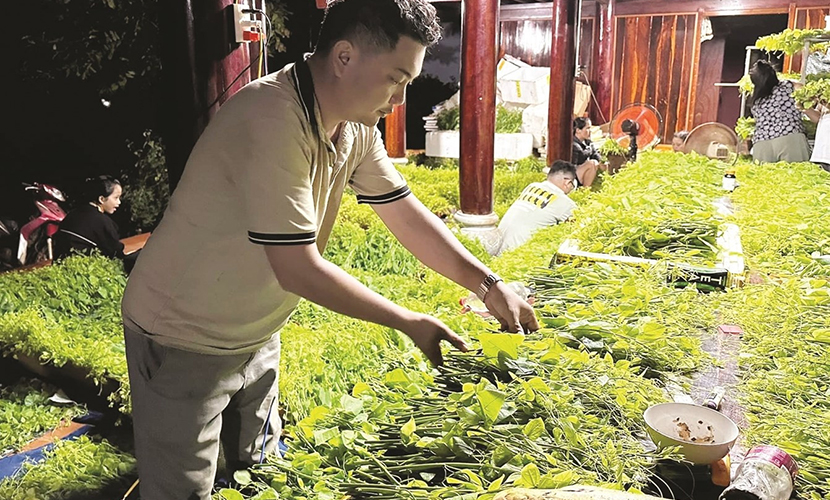
Processing Vietnamese Bo Khai vegetable
Originally a wild and rare forest vegetable, Bo Khai cultivation now follows under strict production standards. Farmers do not use herbicides or chemical fertilizers. Instead, they rely on clean water sources and fermented organic manure. After harvesting, farmers process and pack on-site these vegetables. They then attach traceability codes and branded labels to ensure full compliance with export requirements.
Mr. Hoang Van Hieu said: “The cooperative’s Bo Khai greens are distributed nationwide. For more than two years, we have signed contracts with partners to officially export Bo Khai to China and Cambodia. Volumes reach several hundred kilograms per week, depending on orders.”
Notably, with a solid technical foundation, the cooperative’s organic production model has also been transferred abroad. It has expanded cultivation areas in several border provinces of Cambodia, where Vietnamese expatriates and local farmers jointly participate in farming.
The development journey and growing position of the Bo Khai cooperative vividly demonstrate a transformation in production thinking among ethnic minority communities. No longer cultivating merely for subsistence, the Tày and Nùng people today are engaging in agriculture for export. This creates stable incomes and improves household livelihoods.
If you are interested in Vietnamese Bo Khai vegetable, please contact us:
Company: Agrideco Vietnam Co., Ltd.
Address: No 02, Alley 325 Kim Nguu, Vinh Tuy Ward, Hanoi, Vietnam
Tel/Kakao Talk/Whatsapp: +84 989 649 804
Website: https://agridecovietnam.com
Email: agridecovietnam@gmail.com