

China remains the largest export market for Vietnamese agriculture and continues to offer substantial room for growth. However, the country’s traditional advantages in production capacity and geographic proximity are gradually giving way to stricter requirements on product quality. These also include growing demands for traceability and supply chain development. Competition in the world’s most populous consumer market increasingly depends on exporters’ ability to create higher value-added products. It also depends on their ability to comply with sustainable production standards.
For many years, China has remained the largest export market for Vietnamese agricultural, forestry, and fishery products. Beyond serving as the primary destination for a wide range of tropical fruits and other agricultural commodities, the market of more than 1.4 billion consumers continues to present new opportunities. At the same time, it is also creating new opportunities for further expansion and diversification. It is steadily expanding the list of Vietnamese agricultural products eligible for official import.
However, as bilateral trade continues to grow, China’s import requirements have become increasingly stringent. As a result, Vietnam’s agricultural exports are entering a critical transition. The sector is shifting from competing on production volume to competing on quality, and from short-term transactions to building sustainable, resilient supply chains.
Vietnamese agriculture
In recent years, agricultural cooperation between Vietnam and China has continued to deepen. A series of export protocols have been signed, enabling a range of Vietnamese agriculture to enter the Chinese market through official trade channels. These products include durian, bananas, jackfruit, mangosteen, coconuts, sweet potatoes, passion fruit, and frozen durian.
More than 20 categories of Vietnamese fruits and vegetables are now eligible for official export to China. Meanwhile, several other fruits—including longan, lychee, rambutan, mango, dragon fruit, and citrus varieties—are still undergoing the technical approval process. This is necessary to gain broader market access.
Trade data show that China remains the primary growth driver for Vietnam’s fruit and vegetable exports. In fact, it accounts for approximately 64% of the sector’s total export value. Vietnam also continues to rank as China’s second-largest supplier of fruits and vegetables.
For several key agricultural products, China is by far the most important destination. More than 95% of Vietnam’s durian exports are currently shipped to the Chinese market. Jackfruit exports are similarly dependent on Chinese demand.
Further opportunities are emerging as China’s expanding middle class increasingly seeks high-quality tropical agricultural products. These products must be safe, traceable, and sustainably produced.
In the past, Vietnam’s agricultural exports to China were driven largely by geographical proximity and abundant supply. Today, however, product quality, transparency, and compliance with technical standards have become the decisive factors for market access.
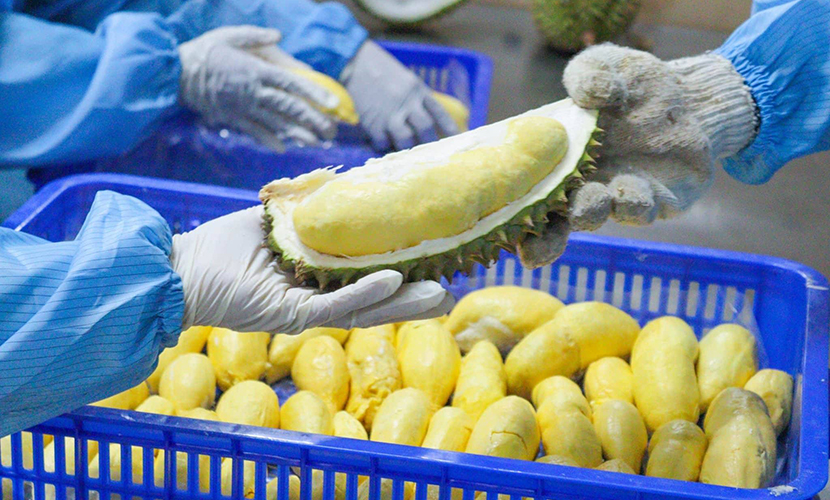
Frozen durian from Vietnam
China has tightened its oversight of growing area codes, packing facility registrations, food safety, phytosanitary requirements, and product traceability. These are no longer recommended best practices. Instead, they are mandatory requirements for Vietnamese agriculture exporters wishing to enter the market.
This shift is forcing Vietnam’s agricultural sector to transform its production model. Small-scale, fragmented farming is increasingly revealing its limitations. Meanwhile, integrated production chains capable of ensuring consistent quality and full traceability are becoming essential.
Industry experts believe that the next phase of growth will depend not simply on exporting larger volumes but on generating greater value from every unit of agricultural output.
One of the most promising strategies, according to many businesses, is to accelerate investment in value-added processing. Compared with fresh produce, processed agricultural products generate higher added value and have a longer shelf life. In addition, they help reduce the pressure of seasonal oversupply.
To achieve this goal, Vietnam’s fruit and vegetable sector needs to develop large-scale production areas with consistent quality standards and full traceability. At the same time, greater investment is necessary in logistics, cold storage, post-harvest handling, and distribution networks.
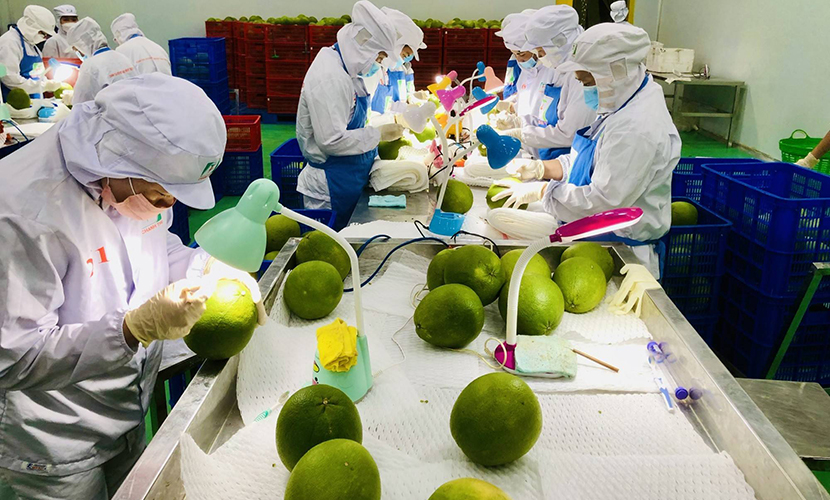
Vietnamese pomelo exports
Businesses also believe that establishing long-term supply chain partnerships between Vietnamese and Chinese companies will help reduce market risks and enhance competitiveness. At the same time, it will help retain a larger share of the value created by Vietnam’s agricultural products.
In addition, the adoption of digital technologies, electronic traceability systems, smart customs, and smart border gates is a key solution. These measures can shorten customs clearance times, lower logistics costs, and improve supply chain transparency.
As demand in the Chinese market continues to expand while import standards become increasingly stringent, the challenge facing Vietnamese agriculture is no longer simply to increase export volumes. Future success will depend on building modern value chains, improving product quality, and meeting the market’s increasingly rigorous requirements.
This transformation will also enable Vietnam to move beyond its traditional role as a supplier of raw agricultural commodities. Instead, it will become a provider of high-value, sustainably produced agricultural products.
Vietnamese source: http://doanhnghiephoinhap.vn/muon-chinh-phuc-thi-truong-trung-quoc-nong-san-viet-khong-the-chi-dua-vao-san-luong-141026.html
If you are interested in Vietnamese agricultural exports, please contact us:
Company: Agrideco Vietnam Co., Ltd.
Address: No 02, Alley 325 Kim Nguu, Vinh Tuy Ward, Hanoi, Vietnam
Tel/Kakao Talk/Whatsapp: +84 989 649 804
Website: https://agridecovietnam.com
Email: agridecovietnam@gmail.com