
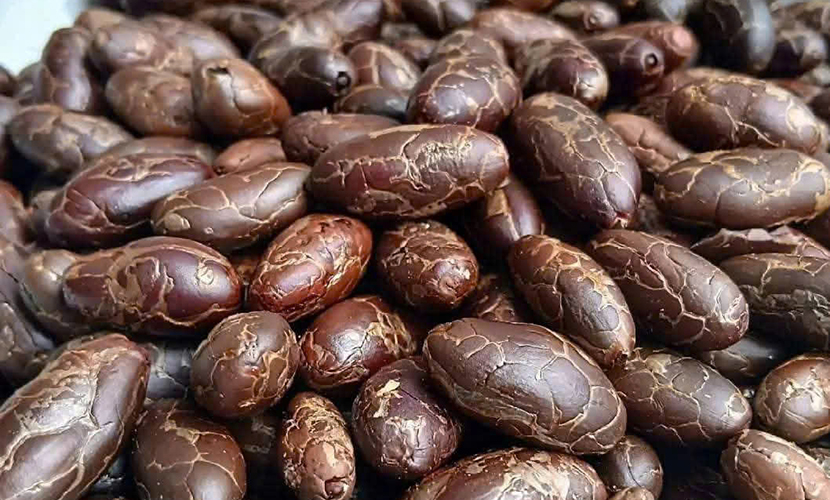
Vietnam has many competitive advantages as it can proactively secure raw materials of Vietnamese cocoa exports. Meanwhile, two of the world’s leading chocolate-producing countries, Belgium and Switzerland, are unable to grow cocoa.
From early April, the United States announced a 10% increase in import tariffs on most foreign goods. Although cocoa does not directly include in the list of taxed products, the market has still affected overall.
This is because the U.S. is one of the world’s largest consumers of chocolate and cocoa. When import costs rise, consumers may cut back on purchases, raising concerns that cocoa demand could decline.
This sentiment has caused global cocoa prices to fall from nearly USD 13,000 per ton to below USD 10,000 per ton within just a few weeks. However, this price level remains high compared to previous years. This is because the global cocoa supply continues to face shortages.
Vietnamese cocoa exports
Global cocoa production is declining sharply. According to the International Cocoa Organization, the previous crop year saw global output fall by nearly 11 percent. This marked the largest supply deficit in almost a decade. The main cause is extreme climate change in key growing regions such as Côte d’Ivoire and Ghana. Together, these countries account for more than 60 percent of the world’s cocoa supply.
However, amid these challenges, Indonesia—the world’s third-largest cocoa producer—is showing positive signs of progress. Farmers there are adopting climate-adaptive farming models to improve the resilience of cocoa trees against climate-related challenges.
Cocoa is a crop that is highly sensitive to environmental conditions. It thrives only in regions near the equator, where temperatures and humidity are stable. Climate change has been a major negative factor affecting cocoa cultivation in many countries around the world. This impact also continues to intensify over time.
In Indonesia, for example, rising temperatures have reduced crop yields. Meanwhile, prolonged rainy seasons have created favorable conditions for the spread of fungi and pests. This has forced many farmers to switch to other crops.
Mr. Tari Santoso, an Indonesian farmer, shared: “Our failures were due to not knowing how to properly care for cocoa trees.”

Vietnamese cocoa powder
To protect their crops and secure family incomes, many farmers in Sumatra, Indonesia—like Tari Santoso—have decided to partner with businesses and non-governmental organizations. Through these partnerships, they aim to change their farming practices.
He is currently working with Krakakoa, a company that has helped train more than 1,000 cocoa farmers across Indonesia. Through this partnership, farmers learn to apply new techniques such as regular pruning and grafting. These methods help promote growth and prevent diseases in cocoa trees.
Mr. Tari Santoso, an Indonesian farmer, said: “In the past, we rarely pruned the trees. We did not understand pruning at all—we did not know what to do and usually just let the trees grow naturally. Now, we can grow cocoa better and produce higher-quality chocolate.”
Beyond training, Krakakoa also provides financial support to farmers. Farmers in Sumatra say that thanks to this cooperation, they have been able to establish a cooperative that offers low-interest loans to farmers. The interest is paid back into the cooperative, rather than to banks outside the community.
The collaboration among farmers, businesses, and non-governmental organizations is opening up new opportunities. At the same time, it is helping Indonesia’s cocoa industry develop sustainably in the face of increasingly severe impacts from climate change.

Vietnamese cocoa nibs
In Vietnam, there are only about 2,000–3,500 tons of Vietnamese cocoa exports each year. This is a modest figure in comparison to major producers such as Indonesia, Côte d’Ivoire, or Malaysia. However, Vietnamese cocoa beans are classified among the rare high-quality cocoa varieties in the world.
Vietnam’s main cocoa export markets include Malaysia, Japan, Belgium, China, and the United States. The products mainly consist of raw cocoa beans, chocolate, and cocoa powder.
Once considered a secondary crop, Vietnamese cocoa is gradually asserting its position. Close cooperation between farmers and businesses, along with favorable climate and soil conditions, drives this progress.
In key cocoa-growing areas such as Đắk Lắk, farmers are entering the harvest season. Unlike in the past, harvesting is now carried out strictly according to technical standards.
Farmers are strictly prohibited from pulling pods by hand. Instead, they must use specialized knives to cut the stems to avoid damaging the trees. The pods are then opened within 24 hours. After that, they are fermented according to company standards.

Vietnamese cocoa beans
About ten years ago, hundreds of households in Đắk Lắk cut down their cocoa trees due to low prices and unstable markets. Today, however, thanks to partnerships with enterprises, cocoa cultivation is making a strong comeback.
Mr. Nguyễn Văn Sỹ is the Director of Ena Cooperative in Krông Na District, Đắk Lắk. He shared: “Currently, cocoa beans are fermented to meet the quality standards set by companies. The purchasing prices range from 235,000 to 240,000 VND per kilogram, providing relatively high income for farmers.”
Not stopping at raw materials, many Vietnamese cocoa enterprises have invested in deep processing. As a result, “Made in Vietnam” chocolate is now available in more than 20 countries.
Mr. Justin Jacquat, Asia-Pacific Cocoa Manager, commented: “Compared to Malaysia, Indonesia, or Côte d’Ivoire, Vietnam’s cocoa output is still very small. But this small scale is actually an advantage, as it offers high quality and unique flavors that create a distinct niche in the premium market.”
According to experts, Vietnam has many competitive advantages as it can proactively secure cocoa raw materials. Meanwhile, two of the world’s leading chocolate-producing countries—Belgium and Switzerland—are unable to grow cocoa. From small garden plots along the Mekong River, Vietnamese cocoa is gradually building its own distinct position. This position is sustainable and full of promise.