

Vietnam is one of the world’s leading exporters of a wide range of popular spices, including pepper, cinnamon, and star anise. Accordingly, Vietnam’s spice exports generate tens of trillions of Vietnamese dong in export revenue for the country each year.
Vietnam has been the world’s leading producer and exporter of pepper for more than 20 years. The country’s cinnamon exports have also ranked first globally since 2022. Meanwhile, it stands third in the world for star anise exports. Vietnamese pepper and spices are now shipped to more than 125 countries. This places Vietnam among the top three spice exporters globally and enables it to dominate many key international markets.
According to data from the Ministry of Industry and Trade, Vietnamese pepper continues to play a leading role in the sector. In 2025, Vietnam exported approximately 240,000–245,000 tons of pepper. This represented a slight decline of 3–5% compared with previous peak periods. However, export value rose strongly to around USD 1.6–1.65 billion. This went up more than 20% compared with 2024, equivalent to over VND 40 trillion.
A significant improvement in average export prices drove this growth. Also, an increasing share of high-quality, value-added, and processed products in total shipments also supported it.
Vietnam’s spice exports
Currently, the United States, the European Union (EU), and the Middle East remain the main destinations for Vietnam’s spice exports. Specifically, three markets account for more than 50% of total export value. These markets are also imposing increasingly strict requirements on food safety, residue levels, and traceability.
While pepper remains the backbone of the industry, cinnamon has emerged as a bright growth driver among spice products in recent years. At the end of 2025, Vietnam’s cinnamon exports reached around USD 300 million. They represented an increase of around 15–20% year-on-year. This is equivalent to approximately VND 7,000–7,500 billion.
Export volumes have grown at double-digit rates, while export value continues to rise thanks to stable demand from key markets. Vietnam is currently among the world’s leading cinnamon exporters, with strong advantages in supply capacity and product diversity.
Beyond its role as a spice, cinnamon also holds significant potential for expansion into processed food, pharmaceuticals, cosmetics, and essential oils. However, the sector still faces several constraints, including fragmented raw material zones, inconsistent quality, and a low level of deep processing. If these bottlenecks are not addressed in a timely manner, the potential for further value growth may begin to plateau, even if production volumes continue to increase.

Vietnam’s cassia cinnamon exports
According to information from the Vietnam Pepper and Spice Association, Vietnam’s star anise exports in 2025 reached approximately USD 50–55 million. This marked a modest increase of 5–7% year-on-year. The main export markets for star anise remain concentrated in China, India, and the Middle East. However, the strongest growth potential lies in essential oils, extracts, and fragrance ingredients. In these segments, value can be several times higher than that of raw material exports.
Alongside traditional spice products, emerging spice categories are also recording notable growth. In 2025, Vietnam’s chili exports surpassed USD 100 million, rising by approximately 30–40% year-on-year. This is equivalent to more than VND 2.5 trillion, driven by strong demand from China and East Asia.
Products such as ginger, turmeric, and other Vietnam’s spice exports, while individually modest in value, collectively generate several hundred million USD annually. They are growing at an average rate of 10–15%, supported by global trends favoring natural foods, functional foods, and Asian cuisine.
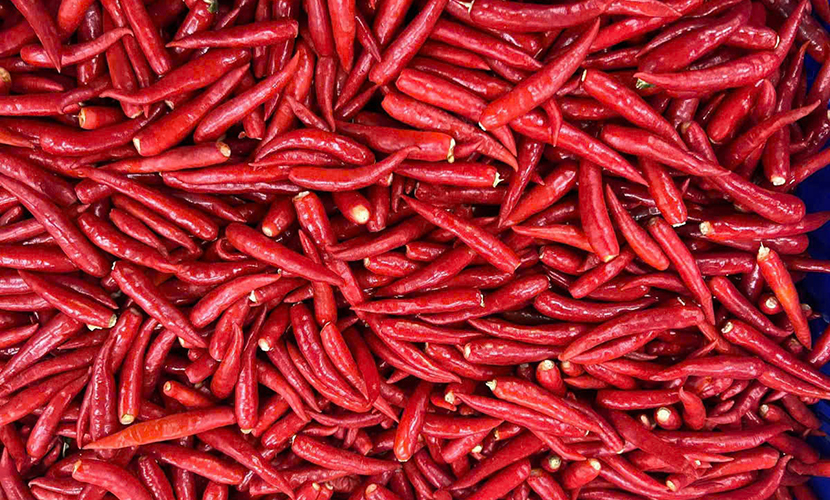
Frozen chili from Vietnam
According to the VPSA, the global spice market in 2026 is likely to maintain stable demand. It is also likely to show slight growth in the mid- to high-end segments. Demand for key spices such as pepper, cinnamon, and star anise is unlikely to increase sharply in the short term due to reduced cultivation areas in some countries and rising production costs. This is creating a relatively firm price base for the 2026–2027 period.
However, major markets are increasingly tightening standards on food safety, traceability, and sustainability. This poses significant risks for exporters who rely solely on raw shipments, intermediaries, and price-based competition. Such players may gradually be excluded from global supply chains.
As a result, Vietnamese spice enterprises should invest systematically in standardized raw material zones and deepen processing capabilities. They should build strong brands in order to fully capitalize on improved price levels and increase profit margins, rather than focusing solely on output volume.
Vietnamese source: https://doanhnghieptiepthi.vn/nam-2026-thi-truong-gia-vi-duoc-du-bao-tiep-tuc-on-dinh-1612601042020358.htm
If you are interested in Vietnamese spice exports, please contact us:
Company: Agrideco Vietnam Co., Ltd.
Address: No 02, Alley 325 Kim Nguu, Vinh Tuy Ward, Hanoi, Vietnam
Tel/Kakao Talk/Whatsapp: +84 989 649 804
Website: https://agridecovietnam.com
Email: agridecovietnam@gmail.com