

The development of the Thai Nguyen tea brand has not only enhanced product value. It has also increased the need to protect its reputation against counterfeit and imitation goods. In this context, brand identity systems are becoming an effective “shield” to help safeguard Vietnamese tea products.
The collective trademark “Thai Nguyen Tea” is not only a source of local pride but has also become an intellectual property asset. It has received the protection from many countries such as the United States, China, Taiwan, Russia, Japan, and South Korea. The issuance of the certification by the National Office of Intellectual Property in August 2006 is an important milestone. It affirms the reputation and prestige of the first specialty product in the province to receive protection.
However, fame often comes with certain negative consequences. Recently, the market has seen cases of counterfeit and imitation products under the Thai Nguyen tea brand. These cases negatively affect consumer health and erode the image of the tea industry. Also, timely preventive measures should protect public health and the brand reputation of this specialty product.
Thai Nguyen is currently the leading province in Vietnam in terms of tea-growing area, yield, and production volume. With around 24,000 hectares of tea cultivation, Vietnamese tea is identified as a key crop. It is the priority for restructuring varieties and promoting the application of science and technology in organic tea production.
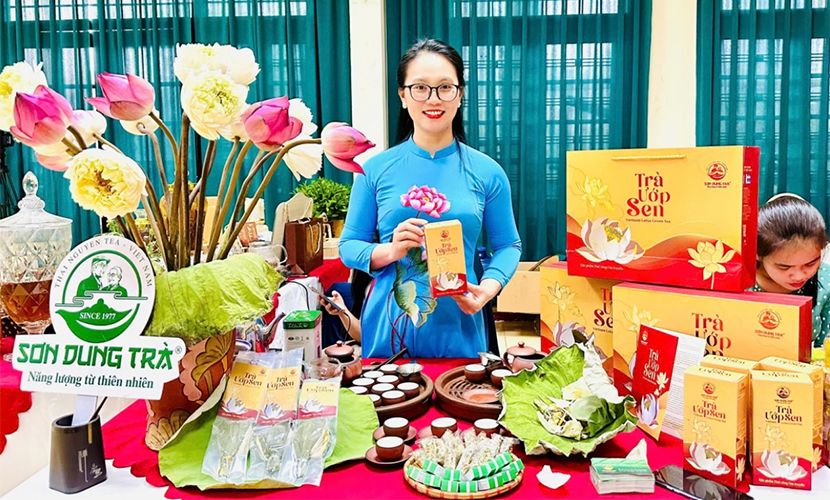
Vietnamese tea products
Fully aware of the risks of intellectual property infringement, the province has directed departments and agencies to coordinate with local authorities to strictly handle violations. From May 7 to May 25, 2026 alone, enforcement forces detected and handled 28 violations related to Vietnamese tea products. They imposed fines totaling 224 million VND, with goods valued at more than 500 million VND. The number of violations increased by 47.3% compared to the same period in May 2025.
Notably, the Department of Science and Technology inspected five production and trading establishments. All of them were found to be infringing the collective trademark “Thai Nguyen Tea” and the Tan Cuong geographical indication. The total administrative fines amounted to 44 million VND. This decisive enforcement not only serves as a warning to dishonest businesses. It also helps restore a transparent business environment, laying a solid foundation for legitimate enterprises to develop.
To combat the problem of counterfeit and imitation products, cooperatives have proactively “equipped” themselves with distinctive brand identity systems. At Van Dung Tea Cooperative, Director Ms. Dao Thi Hong Nhung said the unit has partnered with 20 farming households to produce organic tea. Together, they cultivate a raw material area of more than 5 hectares. All product lines such as loose tea, bud tea, and premium “needle tea” have clear labels on the packaging. In addition, the cooperative has integrated QR codes. These allow customers to directly access the website and accurately trace product origin.
Ms. Dao Thi Hong Nhung affirmed that building detailed brand identity systems for each product design helps customers easily distinguish genuine products from low-quality goods on the market. Thanks to this systematic branding approach, the value of the cooperative’s tea products has increased by 20–30%. Currently, Vietnamese tea products such as loose tea, bud tea, and scented tea have prices between 300,000 VND and 4 million VND per kilogram. This clearly demonstrates that when a brand is properly protected, economic value rises in line with product quality.
Vietnamese tea farms
From another approach, Son Dung Tea Cooperative, with 14 members and nearly 50 associated households, manages 50 hectares of tea plantations in Tan Cuong and Dai Phuc communes. To enhance market competitiveness, the cooperative focuses on producing scented tea lines using flowers such as michelia, jasmine, osmanthus, lotus, and pomelo blossom. Ms. Nguyen Thi Nhu Trang, Director of Son Dung Tea Cooperative, emphasized that every product package includes complete labeling, production address, and contact information. These packages are produced by factories meeting international standards with strict printing processes.
Ms. Nguyen Thi Nhu Trang noted that applying internationally standardized packaging technology has made counterfeiting much more difficult. In contrast, previous methods relied only on stickers, offering weaker protection against counterfeit products. Thanks to a serious branding strategy, the cooperative maintains an annual output of hundreds of tons of dried tea buds. As a result, it supplies stable markets both domestically and internationally. The proactiveness and creativity of cooperatives have enhanced product value. In addition, they have reaffirmed Thai Nguyen tea as a symbol of quality.
Through investment in packaging and brand identity systems, cooperatives have turned their products into distinct value-added goods. The combination of traditional quality and traceability technology is an effective solution for building consumer trust. When consumers can easily distinguish high-quality tea from low-quality products on the market, the brand itself becomes the strongest shield. The close cooperation between local authorities and the proactive innovation of enterprises has helped Thai Nguyen tea maintain its position as the “No.1 tea brand.”
Vietnamese source: https://thuonghieusanpham.vn/khi-thuong-hieu-tro-thanh-la-chan-cho-san-pham-che
If you are interested in Vietnamese tea products, please do not hesitate to contact us:
Company: Agrideco Vietnam Co., Ltd.
Address: No 02, Alley 325 Kim Nguu, Vinh Tuy Ward, Hanoi, Vietnam
Tel/Kakao Talk/Whatsapp: +84 989 649 804
Website: https://agridecovietnam.com
Email: agridecovietnam@gmail.com