

Yên Bái and Lào Cai are the two provinces with the largest Vietnam’s cinnamon cultivation area in the country. Following their merger, the newly formed Lào Cai Province has become a major cinnamon hub. Specifically, it cover a vast cultivation area of 160,000 hectares. This area accounts for up to 80% of the nation’s total cinnamon acreage.
This consolidation expands the province’s cultivated area and concentrated raw material zones. It also opens up opportunities to organize large-scale, value-chain-based production with standardized quality. As a result, it enables the supply of a wide range of Vietnamese cinnamon products to the market.
Once a crop used mainly to recover barren hillsides, cinnamon has gradually helped farmers in what were formerly Yên Bái and Lào Cai provinces escape poverty. As a result, it has also helped create wealthy, even billionaire, farming households. Both provinces have identified Vietnam’s cinnamon cultivation as a multiple purpose with high and stable economic value.
On average, Vietnamese cinnamon generates an income of around VND 50–60 million per hectare per year. This income is significantly higher than that of conventional forestry trees or traditional agricultural crops.

Vietnam’s cinnamon cultivation
According to the latest statistics, the Vietnam’s cinnamon cultivation area across the province after the merger is about 160,000 hectares. Of this, roughly 97,000 hectares are concentration core areas for cinnamon development.
In addition, more than 24,000 hectares have received organic cinnamon cerfitications. Each year, the province harvests and processes around 40,000–45,000 tonnes of dried cinnamon bark. Also, it harvest over 200,000 tonnes of cinnamon branches and leaves.
The province is also home to 16 relatively large-scale cinnamon essential oil extraction plants using boiler-based technology. These plants have a combined capacity of about 1,000 tonnes of essential oil per year. Meanwhile, more than 400 small, household-scale cinnamon oil processing facilities are also in operation.
Sharing common orientations and goals, the province introduced numerous supportive mechanisms and policies with clear directions of cinnamon. The province issued a wide range of central and provincial policies. Also, it applied in an integrated manner to promote the sustainable development of cinnamon raw material areas. These included post-investment support for cinnamon planting at VND 10 million per hectare.
They also include support for building cinnamon value-chain linkages and for obtaining organic certification. In addition, they provide support for the construction of processing and preliminary processing facilities for agricultural and forestry products. There are also pilot mechanisms to support site clearance for agro-forestry-fisheries processing investment projects to attract and encourage investment.

Harvesting Vietnamese cinnamon
Creating favorable conditions and incentives for enterprises and household businesses to invest in production, deep processing, and refined processing has not only helped absorb hundreds of thousands of tonnes of cinnamon (branches, leaves, and bark) locally for farmers. In addition, it has enabled the creation of a diverse range of products that meet domestic and export market requirements. This has thereby increased value added.
According to assessments, Lào Cai cinnamon products are considered the best in the country. In particular, their high essential oil content makes them especially suitable for producing premium essential oils. With high medicinal and economic value, cinnamon has strong consumption potential both domestically and internationally.
As a result, it has become a key product contributing to the enhancement of the local brand in the market. However, the path toward sustainable cinnamon development still faces many challenges. It requires coordinated efforts from farmers, cooperatives, enterprises, and authorities in this new phase.
Lào Cai Province has many favorable conditions to foster and develop an agricultural economy based on cinnamon. In particular, the expansion of cultivated areas and concentrated raw material zones after the merger has created new opportunities for Lào Cai. The province now aims to become a large-scale, commodity-oriented cinnamon production hub. Seizing this opportunity, the province aims to have one-third of its cinnamon area cultivated under organic practices.
By doing so, it will enhance competitiveness in both domestic and international markets. It will also contribute to maintaining Vietnam’s position as the world’s leading cinnamon exporter. The province creates the most favorable conditions to encourage enterprises to expand the Vietnam’s cinnamon cultivation area. It also supports the processing and marketing of cinnamon products in an efficient and sustainable manner.

Removing cinnamon skins
Leaders of the new Lào Cai Province have identified the sustainable, high-value development of the cinnamon industry as one of the key tasks. They aim to link production with processing and consumption in a closed, integrated value chain. The province is focusing all efforts on turning cinnamon into an economic driver.
It aims to transform the vast potential and advantages of its cinnamon raw material areas into tangible value. It also aims to develop cinnamon into a high-income commodity with a national product brand. This will help improve people’s livelihoods and gradually expand into global markets. In turn, it will establish cinnamon as a major agro-forestry export product.
With a clear roadmap in place, Lào Cai Province has set the target that by 2030, forestry will account for nearly one quarter of the agricultural sector’s structure. Medicinal plants — especially cinnamon — will likely to be the core product group. With strong political commitment and a clear strategy, and with vast potential now being unlocked, Lào Cai is demonstrating that cinnamon is a strategic commodity and an economic driver, affirming its pioneering position.
With the clear political determination of local authorities and the active participation and decades-long experience of enterprises, cooperatives, and farmers in cinnamon cultivation, the new Lào Cai Province will enjoy outstanding competitive advantages in both scale and output. They also believe it will become a leading center for cinnamon production and processing in Vietnam and the wider region.
According to experts, Lào Cai now has the opportunity to organize large-scale production along a value chain. It can also build a unified brand with far greater reach than the previously fragmented brands of individual provinces or localities. This concentration also enables authorities to gain a more comprehensive overview.
Drying Vietnamese cinnamon sticks
It allows for more focused direction and the development of effective, coordinated support policies. As a result, trade promotion and product marketing activities can be carried out on a larger and more professional scale. Consequently, Lào Cai cinnamon is able to reach further and access large, high-value consumer markets.
The most vivid evidence of the vitality of cinnamon lies not only in provincial documents and resolutions but also in everyday life and the stories of farmers themselves. Instead of relying on deforestation, spontaneous migration, or low-income wage labor, highland communities now have a stable source of income from Vietnam’s cinnamon cultivation.
Moreover, this income is sustainable and provides long-term benefits. Jobs in processing factories, cooperatives, and preliminary processing workshops also help retain local labor. This gradually forms a new generation of farmers who are technically skilled and business-minded. At the same time, they enjoy decent incomes and contribute to forest protection.
The entire cinnamon value chain — from enterprises and households to individual farmers — is gradually shifting. This change comes as the sector recognizes the value of complying with organic cinnamon production processes. Local people have proactively participated in economic models, boldly applied technological advances, and expanded commodity-based production.
Many young people are also actively involved, combining production with trade. In addition, they use social media effectively to promote cinnamon essential oil, cinnamon powder, and cinnamon tea produced by their families. Cooperatives and enterprises support farmers in applying organic cultivation techniques, care, and preliminary processing.
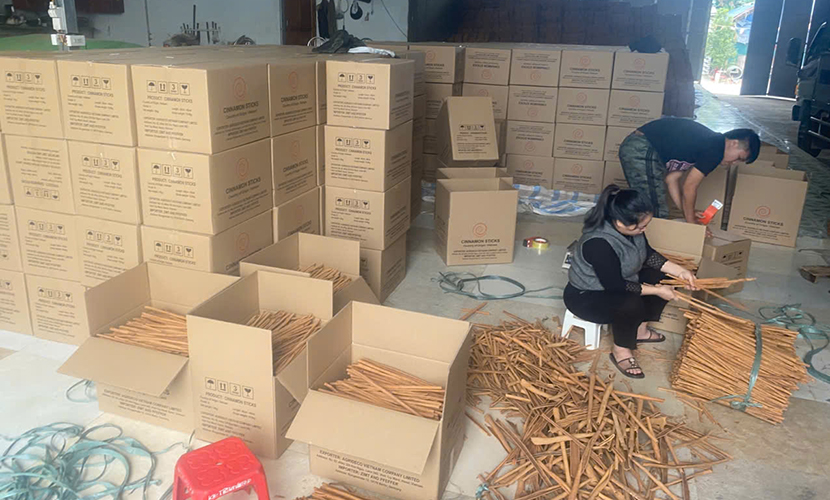
A cinnamon factory of Agrideco Vietnam Co., Ltd.
They also help with marketing, bringing products to international markets in a professional manner. Many households in Lào Cai earn VND 400–600 million per year from cinnamon. As a result, some are becoming billionaires without leaving their homeland.
The strong development potential of the post-merger cinnamon region, along with the expanded and upgraded border gates in Lào Cai, is expected to act as a “magnet” for domestic and foreign investors. In particular, this applies to modern processing plants, warehousing systems, logistics, and agro-processing industrial zones. Recently, the construction of a spice production and processing plant by Agrideco Vietnam Co., Ltd in Lào Cai was officially launched.
This is the first large-capacity, high-tech cinnamon processing plant in the Northwestern highlands. It produces products with values many times higher than raw cinnamon. Notably, the project prioritizes sourcing raw materials from local ethnic minority communities. As a result, it helps create stable jobs and significantly boosts local incomes.
It can be said that an unprecedented golden opportunity is opening up for the Vietnam’s cinnamon industry. With a long-term vision, the province is focusing on deep processing and linking the development of this medicinal crop with eco-tourism. In doing so, it is rising to affirm its pioneering position in the green economy of the Northwest. People in Vietnam’s cinnamon cultivation areas are eagerly awaiting the province’s shared strategic orientations. In particular, they hope these strategies will guide the cinnamon industry to develop in line with its full potential.