

Vietnam seedless limes are one of the well-known crops of My Hiep Commune (Dong Thap Province). In recent years, the My Long Agricultural Service Cooperative has gradually increased the economic value of seedless limes by three to four times compared to traditional farming methods. This improvement has achieved through export activities and deep processing.
Since 2007, several farmers in My Long Commune (now My Hiep Commune) began piloting the cultivation of seedless lime varieties. Over time, production gradually expanded and became associated with the “My Long seedless lime” brand. This variety features a mild sour taste, a light aroma, juicy segments, and notably no seeds.
This is an outstanding advantage for both domestic consumers and export markets. With a relatively short time from planting to harvest, high yields, and year-round fruiting capacity, seedless limes show strong potential. In addition, promising market outlets have helped this crop develop into a specialized cultivation area in My Hiep Commune.
Vietnam seedless limes
However, in the past, market outlets for Vietnam seedless limes were unstable, and prices fluctuated seasonally. To overcome this passive consumption situation, the My Long Agricultural Service Cooperative shifted its approach. Instead of small-scale and fragmented production as before, the cooperative developed a concentrated raw material growing area.
This area complies with Globalgap (Global Good Agricultural Practices) standards. Farmers now cultivate, care for, and harvest limes following unified technical procedures. As a result, product quality is consistent, meeting partners’ requirements for export.
Mr. Le Van Nam is a member of the Board of Directors of the My Long Agricultural Service Cooperative. He said that the commune has strengths in fruit crops such as durian, jackfruit, guava, and seedless limes. In particular, the total area under seedless lime cultivation exceeds 60 hectares. Of this area, around 30 hectares—belonging to more than 30 households—are linked and contracted by the cooperative for output at harvest.
The cooperative has gradually enhanced the economic value of seedless limes through exports and deep processing. As a result, the economic value of seedless limes has increased three to four times compared to selling fresh limes alone as in the past.
To improve the quality of Vietnamese seedless limes and meet export requirements, the cooperative has encouraged farmers to adopt Globalgap standards and organic farming practices. At the same time, it has coordinated with specialized agencies to organize training courses. These activities aim to transfer advanced science and technology to farmers.
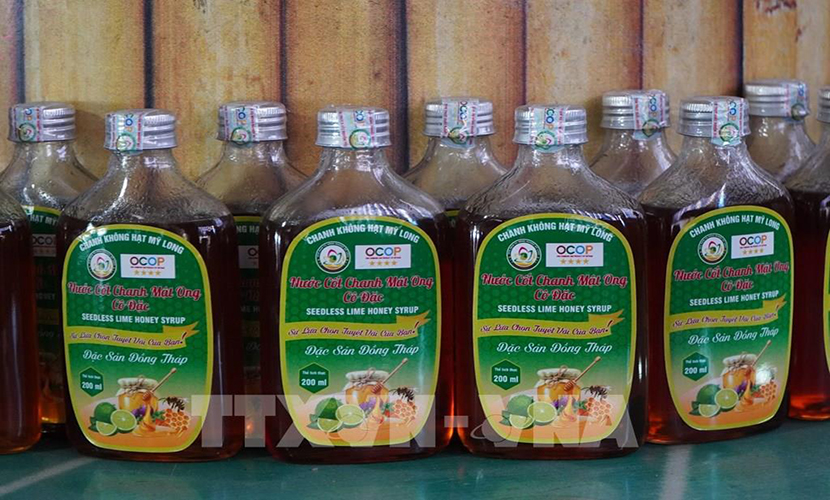
Vietnamese lime juice
The cooperative’s seedless limes have been available steadily to the European market, particularly the Netherlands, for the past six years. For example, in 2024, about 130 tons of Vietnam seedless limes were exported. In 2025, exports of My Long seedless limes to the Netherlands are also expected to reach 130 tons or more.
Growing limes for export requires strict compliance with clean cultivation processes as well as partners’ regulations. In return, if the limes meet standards on fruit size, color, and the absence of pesticide residues, enterprises purchase them at higher prices. These prices are several thousand Vietnamese dong per kilogram higher than market prices. This helps eliminate the situation of “bumper harvest, falling prices” and ensures stable profits for farmers.
Mr. Vo Van Nghiep is a local grower from My Long 3 Hamlet, My Hiep Commune. He shared that he cultivates 1.2 hectares of seedless limes under Globalgap standards. On average, he harvests more than 50 tons annually. He has stuck with this crop for many years because the cooperative supports linkages with Vietnamese export enterprises.
This ensures stable outlets and higher selling prices. About 80% of his lime output is purchased by companies for export. The cooperative buys the remaining volume for domestic fresh consumption and for processing into lime-based products.
Enterprises purchase Grade-1 seedless limes for export to the Netherlands. Meanwhile, Grade-2 and Grade-3 limes are sold domestically through supermarkets and traditional markets. At the same time, the cooperative has researched, produced, and introduced several deep-processed products made from limes.

Vietnamese lime soap
These include honey lime juice and lime soap, and the cooperative is currently studying the production of lime essential oil from lime peel residues. Notably, the honey lime juice product of the My Long Agricultural Service Cooperative has achieved a 4-star OCOP certification. Monthly sales reach 2,000–2,500 bottles of 200 ml each, generating average revenue of VND 130 million per month.
Mr. Le Van Nam is a member of the Board of Directors of the My Long Agricultural Service Cooperative. He added that the production of honey lime juice generates a large volume of lime peel residues. With the aim of reducing environmental pollution and maximizing the economic value of limes, the cooperative is taking action.
With support from science and technology agencies and specialized units, it is researching the production of organic fertilizer from lime peel waste. This fertilizer will be used for lime orchards in particular and fruit trees in general.
Mr. Pham Ba Khiem is a farmer from My Long 1 Hamlet, My Hiep Commune. He shared enthusiastically that he chose to grow Vietnam seedless limes because of easy market access and peace of mind regarding output. Initially, he received experience sharing and technical guidance from cooperative members. As a result, his seedless lime orchard of over two years old has developed well.
The orchard covers more than 1.1 hectares and has begun bearing fruit. In the initial stage, he harvested more than 10 tons. Of this output, about 4 tons were sold to Vietnam’s enterprises for export to the Netherlands at prices ranging from VND 11,500 to 13,500 per kilogram. After deducting production costs, his average profit was about VND 6,500 per kilogram.

Vietnamese seedless lime farm
Recently, a working delegation from the Dong Thap Provincial Party Committee visited the cooperative’s circular economy model in seedless lime production. The delegation acknowledged and highly appreciated the proactive and innovative spirit of the My Long Agricultural Service Cooperative. In particular, she praised its bold shift from traditional production to circular agriculture and smart agriculture.
The delegation emphasized that the model is in line with Dong Thap’s orientation toward ecological agriculture development. It not only helps increase product value but also contributes to environmental protection and the sustainable development of the collective economy. it noted that relevant departments and agencies should continue to support the cooperative. This support should focus on capital, science and technology, trade promotion, and market expansion. The goal is to replicate this model in other localities.
Mr. Le Van Nam is a member of the Board of Directors of the My Long Agricultural Service Cooperative. Accordiing to him, the closed-loop production process applied in seedless lime cultivation brings multiple benefits. It helps reduce input costs, protect the environment, and create safe agricultural products. These products meet the stringent requirements of both export and domestic markets.
In addition, the cooperative has proactively established consumption linkages and expanded market outlets. Through these efforts, income for cooperative members has gradually increased. In the coming period, with support from the government, the cooperative plans to expand the seedless lime growing area to around 100 hectares.
Vietnamese source: https://bnews.vn/chanh-khong-hat-go-cua-thi-truong-the-gioi/399360.html
If you are interested in Vietnamese fresh lime exports, please contact us:
Company: Agrideco Vietnam Co., Ltd.
Address: No 02, Alley 325 Kim Nguu, Vinh Tuy Ward, Hanoi, Vietnam
Tel/Kakao Talk/Whatsapp: +84 989 649 804
Website: https://agridecovietnam.com
Email: agridecovietnam@gmail.com