
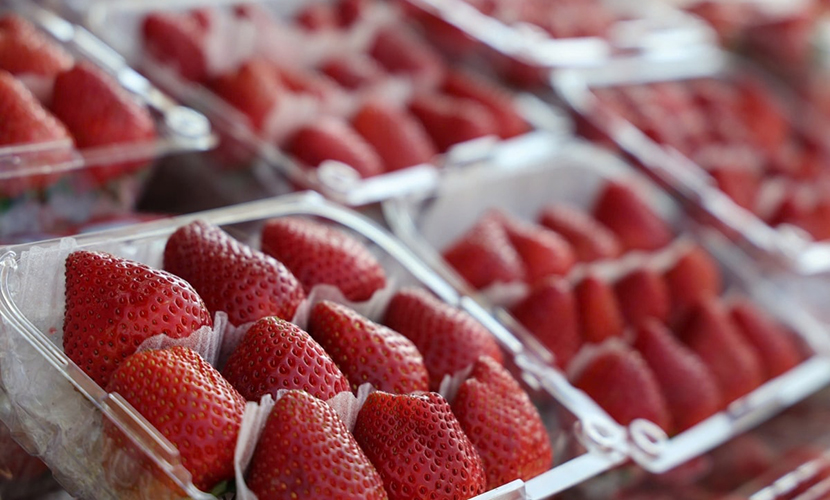
In the positive growth landscape of Vietnam’s fruit and vegetable industry, Vietnam’s strawberry exports are emerging as a remarkable phenomenon. They are recording unprecedented export growth in the first two months of 2026.
According to customs data, while in 2021 Vietnam’s strawberry exports were only around 6,000 USD. This was mainly experimental and on a very small scale. By 2025, the export value had risen to 1.74 million USD. This represents a significant leap for a product that is not traditionally considered a core export strength.
Notably, in just the first two months of 2026, Vietnam’s strawberry exports reached about 3.4 million USD. This is more than double the figure for the entire previous year. Compared to the same period, this marks an increase of over 200,000%, equivalent to roughly 2,000 times. This is the highest growth rate among fruit and vegetable products.
Although its share remains modest at around 0.34% of total export turnover, this rapid growth indicates that strawberries are becoming a new “wildcard” in Vietnam’s agricultural export structure. Unlike key export items such as durian, dragon fruit, or bananas, strawberries belong to the high-value agricultural segment. They require strict quality standards and complex preservation processes.
Vietnam’s strawberry exports
The sharp increase in Vietnam’s strawberry exports reflects a clear shift in Vietnamese fruit enterprises. It shows a move from exporting raw agricultural products toward higher value-added goods.
Currently, Vietnamese strawberries are present in many markets such as China, Japan, South Korea, the European Union, and several Southeast Asian countries. However, most of the export value still comes from processed products such as frozen strawberries, freeze-dried strawberries, or ingredients for food processing. Fresh strawberries account for only a small proportion due to strict requirements on cold-chain logistics and short shelf life.
This indicates that the growth potential of this product remains significant. It is especially strong if Vietnam can improve its logistics capacity and post-harvest preservation systems.
The breakthrough in strawberry exports is closely linked to the expansion of domestic cultivation areas. In recent years, many localities have begun forming concentrated production zones with increasingly large scale.
Sơn La has emerged as a new “strawberry hub” with more than 600 hectares of cultivation in areas such as Mai Sơn and Mộc Châu, with annual output exceeding 10,000 tons. Meanwhile, Lâm Đồng—especially Đà Lạt—continues to maintain its role as a key center with about 170 hectares, developing in the direction of high-tech agriculture.
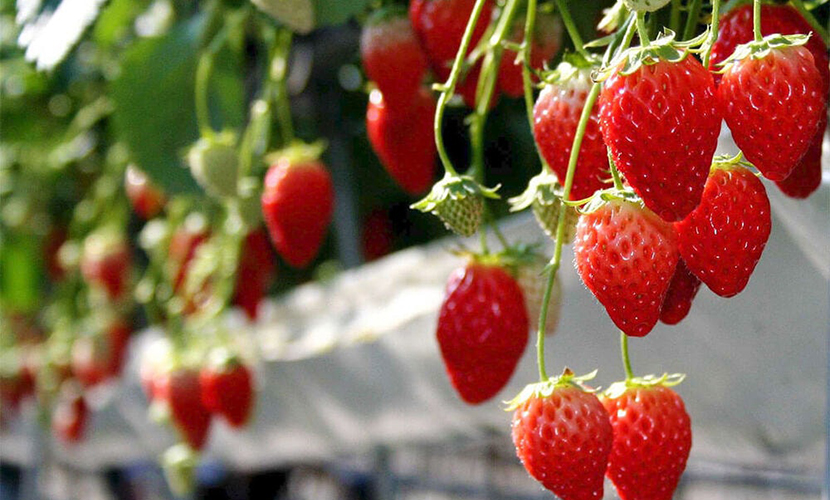
Vietnamese strawberry
In addition, some localities such as Hanoi are also piloting greenhouse strawberry farming models. These models apply drip irrigation technology and environmental control systems. The adoption of techniques such as off-season cultivation, the use of high-quality varieties, and optimized farming processes has helped improve both yield and quality of domestic strawberries.
Beyond fresh consumption, Vietnamese strawberry enterprises are also promoting deep processing such as jam, syrup, and dried strawberry products. This contributes to product diversification and higher added value. A positive signal is that Sơn La strawberries have been served on Vietnam Airlines flights. This helps promote Vietnamese agricultural products to international passengers.
Despite impressive growth, Vietnam’s strawberry exports still face several challenges. The first is market outlets, as the pace of expanding cultivation areas is outpacing consumption capacity. In addition, increasing the share of fresh strawberry exports requires significant investment in cold-chain systems, storage infrastructure, and logistics. These are key factors for competing in the premium segment.
On the international market, countries such as South Korea have built strong strawberry brands with export values reaching tens of millions of USD per year. They focus on high quality and strict standards. Meanwhile, Vietnam has a cost advantage in production. However, it still needs to further improve quality and develop branding to compete effectively.
Experts say that if Vietnam can fully leverage the trend toward high-value agricultural consumption and invest properly in technology, strawberries could become one of the country’s most promising export products in the coming years.
Vietnamese source: https://kinhtechungkhoan.vn/xuat-khau-tang-200-000-loai-nong-san-nay-dang-tro-thanh-mo-tien-moi-cua-thi-truong-viet-1438515.html
If you are interested in Vietnamese strawberry exports, please contact us:
Company: Agrideco Vietnam Co., Ltd.
Address: No 02, Alley 325 Kim Nguu, Vinh Tuy Ward, Hanoi, Vietnam
Tel/Kakao Talk/Whatsapp: +84 989 649 804
Website: https://agridecovietnam.com
Email: agridecovietnam@gmail.com