

Lao Cai province currently has 24,000 hectares of organic cinnamon that meet the stringent standards of international markets. The province aims to have more than 50,000 hectares of organic cinnamon by 2030. It strives to ensure that every forest and every cinnamon-growing area is identified on the global forestry products map and fully traceable in origin. At the same time, it also aims to attract more Vietnamese spice enterprises to invest in local processing. This is the “passport” for Vietnamese cassia products to confidently establish a firm foothold in the world stage.
In recent years, demand for natural and safe medicinal products has increased significantly. Vietnam’s cinnamon products have now been available in 39 countries and territories worldwide. These markets range from less demanding to highly demanding ones. Notably, Lao Cai cinnamon has a high essential oil content, averaging 4.6%.
This makes it particularly suitable for producing premium essential oil aimed at high-value export markets. Many deep-processing enterprises report that they can sell powdered cinnamon and premium essential oil products at prices three to five times higher than raw materials. As a result, these Vietnamese cassia products generate substantial profit margins.
Vietnamese cassia products
According to experts, the global organic spice market is likely to grow by at least 4.6% annually. The cinnamon market alone will estimate to grow at an average rate of 14% per year. In addition, cinnamon is vital material in the food, pharmaceutical, and cosmetic industries. It is also added to coffee, matcha, and various beverages. This clearly presents a major opportunity for Vietnamese cassia products, as cinnamon is a highly favorable spice in many countries.
However, Vietnamese cinnamon products also faces strong competition from Indonesia, Sri Lanka, Madagascar, China, and India. Also, many demanding markets impose very stringent requirements on traceability, organic certification, pesticide residues, and heavy metals. There have been cases where shipments were returned due to quality issues or chemical residues when exported to Europe.
Clearly, for cinnamon to truly become a strategic commodity, deep processing is the key. Agricultural expert Hoang Trong Thuy emphasized that it is necessary to clearly identify target markets for cinnamon products. Based on this, production should be organized according to specific market requirements. Lao Cai province needs to establish geographical indications for organic cinnamon-growing areas in its localities.
It should promote linkages among farming households to form raw material zones. It should also strengthen connections with enterprises and cooperatives for consumption and export. Businesses also need to invest more strongly in raw material areas, processing technologies, and quality inspection.

Vietnamese cassia forest
Mr. Thuy said “To access high-standard markets, products must meet high-quality standards. To achieve this, the province needs appropriate mechanisms and policies to encourage enterprises to invest in preliminary processing, essential oil extraction, and organic cinnamon products. In particular, emphasis should be placed on promoting local processing. At the same time, there should be support for forming cooperatives, cooperative groups, and household groups operating along a linked value chain from production to processing and consumption”.
“Attention should also be given to training and technical guidance for organic and modern cinnamon cultivation, care, and processing. In addition, another equally important factor is support for investment in infrastructure serving the value chain. This includes transportation roads, preliminary processing systems, storage facilities, and agricultural wholesale markets. This is a long-term journey, but it represents a commitment to quality and value. It aims to bring Vietnamese cassia products to more markets around the world,” said agricultural expert Mr. Thuy.
Facing current opportunities and challenges, it is essential to identify deep processing of Vietnamese cassia as the core focus. In particular, enterprises should pay attention to advanced processing lines that create a diverse range of products. Specifically, they include essential oils and cinnamon powder to cinnamon tea and cinnamon confectionery. Planning concentrated cinnamon raw material areas linked to specific microclimates and soil conditions is an urgent requirement.
The development of a real-time digital map of cinnamon cultivation is especially important. It helps with planning, managing cinnamon forests, conserving genetics, and guiding development. This digital cinnamon map will also serve as a marketing tool. As a result, it will give businesses confidence in the supply and quality of local cinnamon.
Lao Cai province has set a clear goal of establishing a high-tech agricultural and forestry processing center. This aims to increase added value for its key products, including cinnamon, star anise, and medicinal herbs.

Fresh cinnamon from Vietnam
The province also seeks to build integrated production–processing–consumption value chains. At the same time, it plans to attract private and foreign direct investment (FDI) into the agricultural products. Additionally, it aims to promote concentrated, sustainable production by harnessing the combined strengths of farmers, enterprises, and government authorities.
In reality, the export value of Vietnamese cassia products has not yet matched its potential and advantages. They are mainly exported through intermediaries, which results in unstable prices and markets as well as relatively low value. Currently, the Government is developing an ecosystem to help the cinnamon industry leverage free trade agreements (FTAs).
Under this initiative, the main objectives are to help enterprises maximize the benefits of FTAs. It seeks to foster a culture of connectivity and cooperation. At the same time, it strengthens collaboration between regulatory agencies and businesses to drive the development of the cinnamon sector.
Mr. Ngo Chung Khanh is the Deputy Director General of the Multilateral Trade Policy Department. He stated that the FTA utilization ecosystem for the Vietnamese cinnamon industry will support cinnamon-growing households. In particular, it helps them access credit and receive cultivation guidance that meets export standards. It also promotes the application of international production standards such as HACCP and GMP, USDA Organic and EU Organic.
Importantly, farmers should guarantee stable market access through contracts signed with spice enterprises within the ecosystem. They also receive support in addressing challenges encountered during cultivation. This is an inevitable pathway to enhancing competitiveness and increasing export value in the medium and long term.
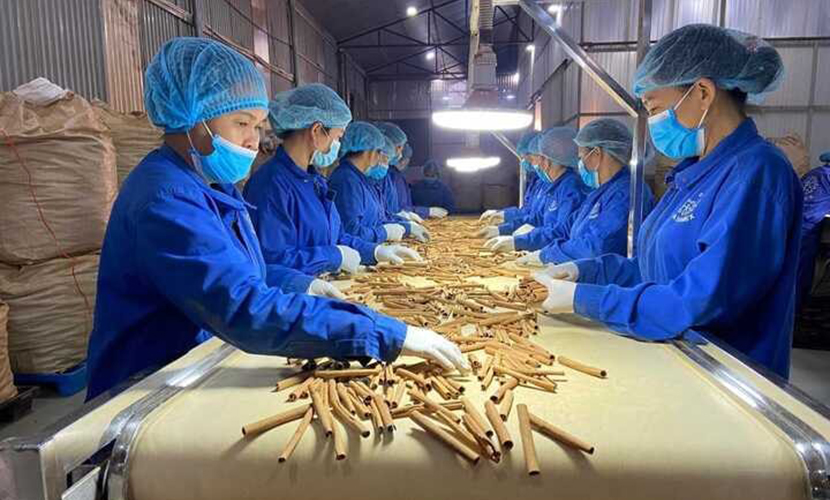
Vietnamese cassia sticks
Ms. Hoang Thi Lien is the Chairwoman of the Vietnam Pepper and Spice Association. She said the first priority is to gain a clear understanding of target markets and commitments under FTAs. This includes regulations on tariffs and quality standards in agreements such as the EVFTA and UKVFTA in order to successfully enter these markets.
Once understanding the market, it becomes possible to organize production in a scientific and systematic manner. This organization must align with the requirements of importing countries. From there, enterprises can build brands and credibility in global markets through international standards.
Ms. Lien also noted that the ecosystem will help connect the government’s international trade commitments with real-world implementation by Vietnamese cassia businesses. In this ecosystem, enterprises act as the executors, transforming these commitments into tangible outcomes such as export value growth and penetration into new markets. When the benefits and value of the ecosystem become clear, farmers and businesses will naturally and proactively participate.
Many experts agree that specific policies—like providing seedlings, offering preferential loans, or crop insurance—are important. However, long-term policies should to ensure the sustainable development of the cinnamon industry. The focus should be on building and promoting the Vietnamese cinnamon brand in both domestic and international markets under identities such as “Vietnam Cinnamon” and “Vietnam Cinnamon Essential Oil”.
It should also include organizing trade fairs and exhibitions to introduce cinnamon products to consumers. In addition, it should involve researching and assessing additional potential value derived from cinnamon. This would help promote value-added solutions, including opportunities in carbon markets and the value of cinnamon by-products.

Vietnamese split cassia
Furthermore, to prevent cinnamon cultivation from expanding in an unsustainably rapid manner that disrupts local crop planning, it is necessary to clearly define land availability, planting scale, and quality control of growing areas. To sustainably develop this spice crop, Lao Cai should focus not only on expanding acreage but also on deep development of Vietnamese cassia products. This includes variety planning, quality management, linkages, and processed cassia products.
Measures such as assigning planting area codes, ensuring traceability, and obtaining organic and Vietgap certifications are essential to guarantee qualified inputs for export-standard processing plants. Support should play a vital role in technology transfer in Vietnamese cinnamon cultivation, harvesting, and leaf preservation. This will help ensure high essential oil content and product quality that meets the requirements of target markets.
To establish a firm foothold in demanding markets and turn the dream of “green gold” into reality, Lao Cai needs a comprehensive development strategy. This strategy should encompass raw material zoning, investment in processing, market connectivity, and the development of local human resources.
Additionally, it should include research and close alignment with policies to seize opportunities from FTAs. If invested in and developed in the right direction, Vietnamese cinnamon will not only remain a “specialty product”. It will also become a new economic symbol of the highlands. In this way, ethnic communities can not only escape poverty but also achieve prosperity with confidence and self-reliance.
Vietnamese source: https://daibieunhandan.vn/khat-vong-vuon-tam-cua-thu-phu-que-lao-cai-bai-2-tam-ve-thong-hanh-dua-que-ra-the-gioi-10393988.html
If you are interested in Vietnamese cassia exports, please contact us:
Company: Agrideco Vietnam Co., Ltd.
Address: No 02, Alley 325 Kim Nguu, Vinh Tuy Ward, Hanoi, Vietnam
Tel/Kakao Talk/Whatsapp: +84 989 649 804
Website: https://agridecovietnam.com
Email: agridecovietnam@gmail.com