
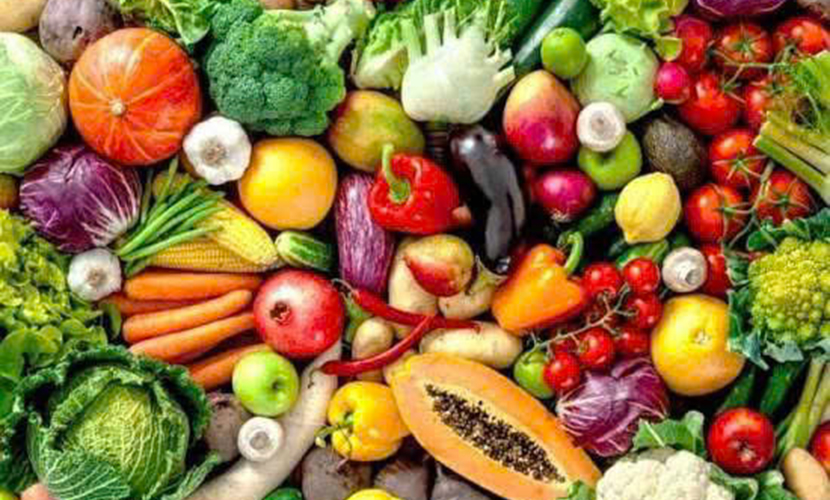
China continues to offer significant growth opportunities for Vietnamese fruit and vegetable exports. Growing-area codes and packing-facility codes have become key factors in expanding the market share of Vietnamese produce exports.
Nguyen Quoc Manh is the Deputy Director General of the Plant Production and Protection Department. He said that Vietnam’s fruit and vegetable sector has experienced strong growth in both production and exports in recent years. The industry has become one of the fastest-growing segments of the crop-production sector. It has made an important contribution to crop restructuring and increasing agricultural value.
According to Manh, market-access efforts have achieved encouraging results, particularly in China, Vietnam’s largest importer of fruits and vegetables. The two countries have signed numerous export protocols covering a wide range of products. These include durian, mangosteen, jackfruit, bananas, coconuts, passion fruit, sweet potatoes, grass jelly, and frozen durian. At the same time, both sides are continuing negotiations of export requirements for longan, lychee, rambutan, mango, dragon fruit, and citrus fruits.
Among export commodities, Vietnamese durian has emerged as the most dynamic growth driver. During the 2021–2025 period, Vietnam exported more than 3 million tons of fresh durian and nearly 190,000 tons of frozen durian. Currently, fresh Vietnamese durian is imported by 28 countries, while frozen durian is exported to more than 20 countries. China accounts for over 95% of Vietnam’s total durian export volume.
Vietnamese produce exports
Vietnam has also exported more than 3.2 million tons of jackfruit worldwide. Approximately 99% of this volume was destined for the Chinese market. These figures highlight the enormous potential of Vietnamese produce exports in the world’s most populous consumer market.
However, Manh noted that importing countries are imposing increasingly stringent requirements. These requirements relate to food safety, traceability, growing-area codes, packing-facility registration, environmental protection, and carbon-emission reduction.
China, in particular, has tightened its management of growing-area and packing-facility codes, as well as phytosanitary requirements. According to Manh, this is the time for Vietnamese produce exports to shift from a growth model based on output volume to one driven by quality, value creation, and sustainable development.
For the Chinese market, the focus should extend beyond exporting fresh produce. Greater emphasis is necessary to place on processing and deep processing. It is also necessary for developing standardized production areas, strengthening traceability systems, and improving logistics infrastructure.
“The Vietnamese fruit and vegetable industry needs to move from a production mindset to an agricultural-economy mindset—from exporting what we have to producing what the market demands. Only by meeting requirements related to quality, transparency, and sustainability can Vietnamese produce increase its value and expand its share in international markets,” Manh emphasized.
Mr. Vu Ba Phu is the Director General of the Trade Promotion Agency under the Ministry of Industry and Trade. He said that Vietnam’s fruit and vegetable exports reached USD 8.56 billion in 2025. This figure was up nearly 20% from the previous year. Exports to China alone totaled approximately USD 5.5 billion.
According to Phu, alongside traditional trade channels, the rapid development of China’s e-commerce sector is reshaping distribution activities. Online retail platforms and modern distribution networks are increasingly replacing the role of traditional wholesale markets.
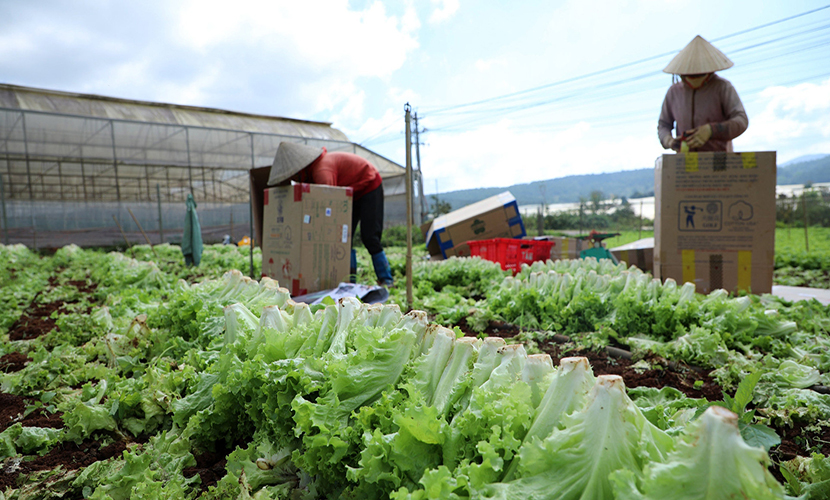
Vietnamese fresh vegetable farm
At the same time, new transportation routes and smart border-gate systems are helping shorten delivery times, reduce costs, and improve customs-clearance efficiency. Nevertheless, these opportunities are accompanied by mounting pressure. China continues to refine its import regulations and enforce stricter requirements concerning growing areas, packing facilities, traceability, and food safety.
Phu pointed out that the success of durian exports demonstrates the tremendous potential of Vietnamese agricultural products in China. However, such success cannot automatically be replicated across other commodities. If Vietnam continues to rely on exporting raw materials and competing primarily on price, growth opportunities will gradually narrow.
Therefore, the priority in the coming period is not only market access but also the development of a sustainable export ecosystem. This includes establishing standardized raw-material zones and investing in deep processing. In addition, it involves enhancing logistics and cold-chain capabilities, promoting cross-border e-commerce, and strengthening cooperation among government agencies, local authorities, industry associations, and businesses.
Mr. Nguyen Dinh Tung is the Chairman and CEO of Vina T&T Group. He said that a durian, pomelo, or coconut exported to China must not only be of the highest quality but also carry a transparent “passport.” This passport documents its cultivation, harvesting, and packing processes.
As the Chinese market places increasing importance on transparency and traceability, standardizing production areas and completing the registration of growing-area and packing-facility codes have become urgent priorities. These requirements are not only essential for maintaining market access. They also serve as a foundation for increasing product value, expanding market share, and achieving sustainable growth.
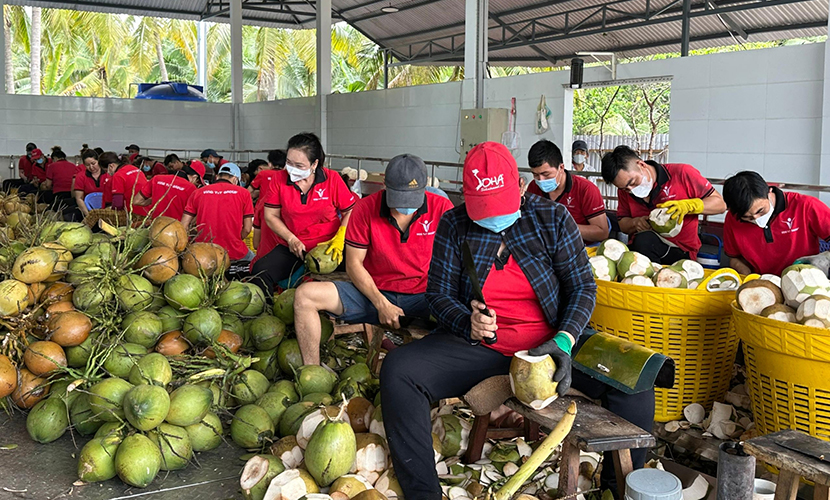
Vietnamese coconut factory
According to Tung, one of the major challenges currently facing businesses involves the approval and issuance of growing-area and packing-facility codes. Possessing these codes is effectively the “key” to entering the market for Vietnamese agri-businesses. However, the current pace of assessment and approval has not kept up with business demand. Such delays not only disrupt trade activities but also increase opportunity costs for both Vietnamese farmers and Chinese importers.
To create a breakthrough in the standardization of growing areas and packing facilities, Tung proposed three key solutions for consideration by the Chinese authorities. These proposals are directed particularly at the General Administration of Customs of China and related agencies.
First, accelerate the assessment and approval process by increasing the frequency of online inspections for growing areas and packing facilities that have already submitted applications. Alternatively, authorities could consider mechanisms that authorize reputable inspection organizations in Vietnam to conduct preliminary risk assessments.
Second, establish a “green lane” priority customs-clearance mechanism for enterprises and growing areas that have obtained compliant codes. These entities should also maintain strong records of regulatory compliance and successfully implement green-transition models to ensure product quality and freshness.
Third, promote digital data connectivity between the quarantine authorities of both countries. This would enable real-time updates of growing-area code status and facilitate business access to information. In addition, it would help prevent fraud and misuse of registration codes that could damage the reputation of Vietnamese agricultural exports.
Vietnamese source: https://thuehaiquan.tapchikinhtetaichinh.vn/chuan-hoa-vung-trong-de-rau-qua-viet-chinh-phuc-thi-truong-trung-quoc-159870.html
If you are interested in Vietnamese produce exports, please do not hesitate to contact us:
Company: Agrideco Vietnam Co., Ltd.
Address: No 02, Alley 325 Kim Nguu, Vinh Tuy Ward, Hanoi, Vietnam
Tel/Kakao Talk/Whatsapp: +84 989 649 804
Website: https://agridecovietnam.com
Email: agridecovietnam@gmail.com